



Illuminating Martian Night
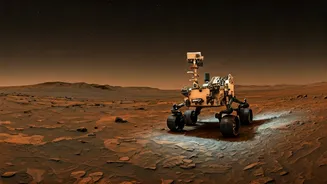
In a groundbreaking achievement, NASA's Curiosity rover has managed to capture an exceptionally rare nighttime photograph of the Martian landscape. This
unique image was acquired on December 6, 2025, during the 4,740th Martian day, or 'sol,' of its ongoing mission. Nighttime imaging on Mars is an infrequent occurrence because rovers typically depend on solar illumination to operate their cameras. To achieve this rare snapshot, Curiosity employed small LED lights strategically positioned on its robotic arm. These lights, part of the Mars Hand Lens Imager (MAHLI) instrument, effectively acted as miniature spotlights, bathing a section of the surface in light. This illuminated patch was then captured by the Mastcam, a camera situated on the rover's 'head,' offering an unprecedented view of the terrain after sunset.
Nighttime Vision Revived
The application of Curiosity's LED lights for nighttime photography is a rare but valuable technique that scientists have previously explored. Typically, the MAHLI instrument's lights are utilized during daylight hours to peer into shadowed crevices and hard-to-reach areas, such as the interior of drill holes or the rover's own nooks and crannies. However, the decision to deploy these lights for a dedicated nighttime imaging session was rekindled after Curiosity drilled into a rock formation designated 'Nevado Sajama' on November 13, 2025. Engineers observed that the freshly exposed walls of this drill hole exhibited a smoother texture than usual. This observation sparked the idea that illuminating these smooth surfaces in the dark could potentially reveal intricate geological details that might otherwise remain obscured, thus reigniting interest in nighttime imaging capabilities for detailed analysis.
Boxwork Formations Unveiled
The specific region where Curiosity drilled into 'Nevado Sajama' is characterized by an extraordinary geological phenomenon known as 'boxwork' formations. These striking patterns consist of a network of interlocking ridges that extend for considerable distances across the Martian surface. When viewed from above, such as from orbit, these formations present a visual resemblance to colossal spiderwebs, making the area exceptionally captivating for scientific investigation. The choice to illuminate the drill hole in this particular locale was driven by the unique geological context. The smoother walls of the drill hole, when lit by the rover's LEDs during the Martian night, offered an opportunity to study the internal structure and composition of these ancient rocks with enhanced clarity. This rare nighttime image allows scientists to examine these formations more closely, potentially unlocking new insights into Mars's geological past and the processes that shaped its surface.
Curiosity's Enduring Mission
Since its landing in 2012, NASA's Curiosity rover has been diligently exploring the Martian surface, embarking on a slow ascent of Mount Sharp. The primary objective of this long-term mission is to investigate the planet's ancient environmental conditions. The sophisticated rover was engineered and is managed by NASA's Jet Propulsion Laboratory, located in California. The essential imaging instruments involved in this nighttime photograph, the Mastcam and MAHLI cameras, were developed and are presently operated by Malin Space Science Systems, a company based in San Diego. This latest achievement underscores the rover's continued scientific utility and its capability to push the boundaries of Martian exploration, even after years of operation, by employing innovative techniques to capture unprecedented data.