







A New Cosmic Milestone
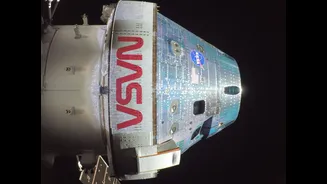
The Artemis II mission has etched its name in the annals of space exploration by setting an unprecedented distance record for human travel from Earth.
During its six-hour lunar flyby, the crew ventured farther into space than the legendary Apollo 13 mission accomplished in 1970. This remarkable achievement signifies a monumental leap in our ongoing quest to explore the cosmos and is a crucial precursor to future lunar endeavors. The astronauts, a mix of American and Canadian talent, are not just setting records but also laying the groundwork for boots on the lunar south pole within the next two years, marking a significant return to the moon since the Apollo era. The mission's trajectory, a testament to clever orbital mechanics, utilizes the gravitational pull of both Earth and the Moon, allowing for a fuel-efficient journey. This celestial figure-eight path is designed for a safe return, bringing the crew back home after their groundbreaking excursion.
Echoes of Apollo's Legacy
As the Artemis II spacecraft soared towards its record-breaking distance, the astronauts carried with them a poignant reminder of past lunar pioneers. A message from Apollo 13 commander Jim Lovell, who sadly passed away shortly before the mission, welcomed the crew to his 'old neighborhood.' Lovell, a veteran of both Apollo 8 and 13, shared his well wishes, urging the crew to cherish the extraordinary views. Adding to this historic connection, the Artemis II astronauts brought along the very silk patch that accompanied Lovell on his Apollo 8 journey, humanity's first expedition to the moon. Commander Reid Wiseman expressed the profound honor of carrying this artifact, a symbol of the continuum of human exploration and the shared dream of reaching for the stars. This blend of past and present underscores the enduring spirit of discovery that drives these ambitious space missions.
Scientific Sightseeing
Beyond the sheer distance covered, the Artemis II mission was packed with scientific objectives and spectacular sightseeing opportunities. The crew aimed to closely observe the Orientale Basin, a massive impact crater spanning nearly 600 miles, notable for its distinct three-ring structure. They also sought to cast their gaze upon the landing sites of Apollo 12 and Apollo 14, locations steeped in lunar history. Furthermore, the mission provided unique views of the lunar south polar regions, an area of intense interest for future crewed landings. The astronauts' trajectory was designed to offer unparalleled perspectives, even allowing for the observation of a total solar eclipse from behind the moon. NASA geologist Kelsey Young anticipated thousands of photographs, capturing the profound beauty and scientific value of these lunar landscapes for people across the globe, fostering a universal connection to our celestial neighbor.
Paving Future Missions
The Artemis II mission is far more than just a record-breaking voyage; it is a critical stepping stone for NASA's ambitious Artemis program. Following this successful lunar flyby, the program is set to intensify its efforts to return humans to the moon. The subsequent Artemis III mission is slated to involve an Orion crew practicing docking procedures with lunar landers while in Earth's orbit. This will be followed by the ultimate goal of Artemis IV in 2028: a crewed landing near the moon’s south pole. This strategic approach, building upon each mission's successes, ensures a methodical and robust path towards sustained human presence on the lunar surface. The lessons learned and the technological advancements demonstrated by Artemis II are foundational to achieving these larger, long-term objectives.