





AI's Growing Capability
Recent extensive research, drawing from millions of real-world interactions with AI assistants like Claude, indicates that generative AI is now proficient
in undertaking a substantial portion of tasks across numerous professions. This intelligence isn't just theoretical; it's actively being integrated into daily work routines. The study found that a significant 49 percent of all jobs have at least a quarter of their duties that AI tools could potentially manage. This figure represents a notable escalation from previous forecasts, highlighting the rapid advancement and adoption of AI in the professional sphere. The primary applications of AI are currently observed in sectors demanding cognitive effort, such as writing, programming, data analysis, and administrative functions. Rather than outright replacement, AI is frequently acting as a powerful augmentative force, enabling individuals to complete their responsibilities with greater speed and efficiency. This pervasive integration, however, signals a profound shift on the horizon for the global workforce as AI becomes an increasingly common feature in day-to-day operations.
Roles Under Pressure
Jobs heavily reliant on predictable digital processes are identified as the most susceptible to automation by AI systems. This includes professions like coding, where intricate algorithms can be generated and debugged by AI, as well as data processing, which involves the manipulation and analysis of vast datasets. Customer support roles are also highly vulnerable, as AI chatbots can handle a significant volume of inquiries, provide instant responses, and manage routine customer interactions. Industry analysis suggests that for programmers, customer support staff, and data processing specialists, potentially as much as 70 percent of their current tasks could be automated. Beyond these technical fields, the report also flags administrative roles, office support functions, legal research and documentation, financial analysis and reporting, content creation, and translation services as being at significant risk. The common thread among these vulnerable professions is their engagement with information, a domain where large language models, the backbone of generative AI, excel due to their advanced text comprehension and generation capabilities.
Shifting Landscape
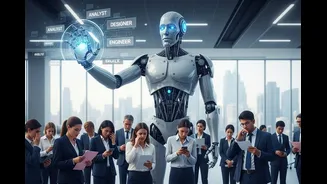
Unlike prior industrial revolutions that primarily reshaped manufacturing and manual labor, the current wave of automation driven by generative AI is distinctly targeting knowledge work, often referred to as 'white-collar' jobs. This is largely due to AI's escalating proficiency in analyzing complex text, generating comprehensive reports, creating software code, and processing diverse data streams, all capabilities previously exclusive to human intellect. This fundamental shift is anticipated to precipitate a monumental transformation within the labor market. Some analysts, citing reports from prominent business publications, have even warned of a potential "great recession for white-collar workers" if a large number of office-based positions are automated concurrently. While the immediate impact might seem daunting, economists generally believe that technology's role is more likely to be one of job evolution rather than outright elimination, suggesting a future where roles are redefined rather than eradicated.
Future Outlook
Despite the concerns surrounding automation, historical patterns of technological advancement suggest that new jobs will emerge even as others become obsolete. Historically, major technological shifts have not only displaced existing roles but also given rise to entirely new industries that were unimaginable beforehand. Many professions commonplace today simply did not exist a few decades ago. Similarly, the widespread adoption of AI is expected to foster new employment opportunities in areas such as the development, training, and ongoing management of AI systems themselves. Furthermore, the interaction between humans and AI, as well as the creation of more sophisticated AI-driven software solutions, will likely demand new specialized skills. Companies that successfully integrate AI into their operations may also experience growth, leading to the creation of additional roles as their product and service offerings expand. The future of work, therefore, is not necessarily a zero-sum game between humans and machines but rather a complex reconfiguration of tasks within existing jobs and the birth of entirely new career paths.