






Drone Engagement
In a significant escalation of maritime tensions, a US aircraft carrier operating in the Arabian Sea engaged and destroyed an Iranian unmanned aerial vehicle.
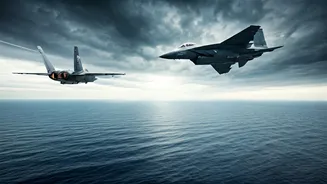
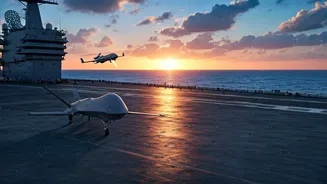
The incident occurred on Tuesday, involving the USS Abraham Lincoln. According to US military officials, the drone made what was described as an "aggressive approach" towards the carrier, prompting defensive measures. An F-35C fighter jet, launched from the USS Abraham Lincoln, was instrumental in neutralizing the threat. The US Central Command (CENTCOM) confirmed that no American personnel were harmed, nor was any US equipment damaged during this encounter. The drone's persistent trajectory toward the vessel, even after de-escalatory efforts by US forces present in international waters, led to its destruction. This action underscores the precarious security situation and the potential for miscalculation in the strategically vital Arabian Sea region.
Maritime Confrontation
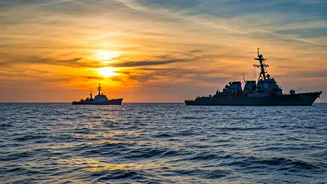
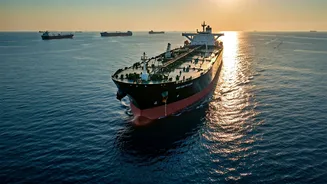
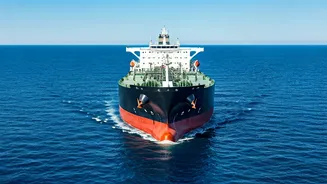
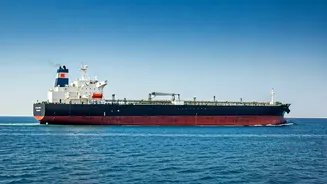
Following the drone incident, a series of concerning maritime events unfolded in the Strait of Hormuz. Shortly after the US forces downed the Iranian drone, two gunboats belonging to Iran's Islamic Revolutionary Guard Corps (IRGC) made a close approach to a US-flagged chemical tanker, the M/V Stena Imperative. These Iranian vessels reportedly maneuvered at high speeds around the tanker on three separate occasions while an Iranian Mohajer drone observed from above. During these aggressive passes, the IRGC boats issued radio threats to board and seize the tanker, which was lawfully operating in international waters. US military assets, including the USS McFaul, were quickly deployed to the scene. The USS McFaul provided an escort to the M/V Stena Imperative, ensuring its safe passage away from the threatening vessels. This rapid response, supported by defensive air cover from the US Air Force, helped to de-escalate the immediate confrontation. CENTCOM characterized these actions as representative of Iran's "unprofessional and aggressive behavior," highlighting the increased risk of accidental escalation for all vessels navigating the region's international waters.
Diplomatic Undercurrents
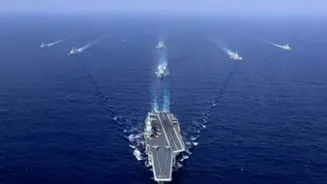
This drone engagement occurred against a backdrop of anticipated diplomatic engagement between the United States and Iran. The incident unfolded just days before scheduled talks aimed at preventing further military escalation in the region. Reports indicated that these negotiations were already facing challenges, with Tehran reportedly seeking alterations to the agreed-upon venue, participant list, and the overall scope of the discussions. In parallel, the US has significantly bolstered its military presence in the Middle East over the preceding week. This includes the deployment of the Abraham Lincoln Carrier Strike Group, accompanied by three guided-missile destroyers and its comprehensive carrier air wing, which features advanced aircraft such as the F/A-18E Super Hornet, F-35C Lightning II, and EA-18G Growler. Additionally, three US Navy destroyers – the USS McFaul, USS Delbert D. Black, and USS Mitscher – are reportedly operating independently in the region, further solidifying the US military posture in response to evolving geopolitical dynamics.
Iranian Perspective
In response to the events, Iranian media offered a different narrative, stating that a drone belonging to Iran's armed forces had successfully completed a "surveillance mission" in international waters on the same Tuesday. This official statement emerged shortly after the US military announced it had downed an Iranian aircraft. Citing unnamed sources, the Fars news agency reported that the drone had effectively monitored military movements in areas adjacent to Iran, transmitting real-time data back to its ground bases. The report emphasized the critical role of such missions in the "overall monitoring" of the region. Meanwhile, Iran's semi-official Tasnim news agency quoted an unnamed source indicating that the nation had lost communication with one of its drones. The cause of this loss of connection is reportedly under investigation, with details to be released once a determination has been made. This divergence in reporting highlights the complex information landscape and differing perspectives surrounding the incident.