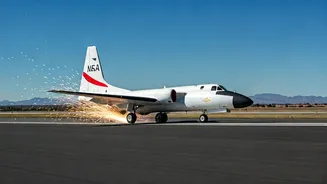









Emergency Belly Landing
On Tuesday, a NASA research aircraft, a WB-57, was compelled to execute an emergency landing at a Texas airport. The aircraft experienced a mechanical
malfunction, which meant the landing gear could not be deployed. Footage shared online showed the plane skidding down the runway, with flames and smoke emerging beneath it as it attempted to stop. Emergency services, including fire crews, were immediately present at the scene, as shown in video footage. The aircraft eventually came to a complete stop on the runway, with the cockpit hatch open and emergency vehicles positioned around it. NASA confirmed that the incident was due to a 'mechanical issue' and that an investigation would be launched to determine the precise cause of the malfunction. Fortunately, both crew members on board were reported to be safe following the incident.
The WB-57 Aircraft
The aircraft involved in the incident was a NASA WB-57. This high-altitude research plane is recognized for its unique, long, and slender fuselage. The WB-57 has a twin-seat jet configuration and is designed to fly for about six and a half hours at altitudes exceeding 63,000 feet (19,200 meters). NASA has been using the WB-57 for scientific and atmospheric research missions since the 1970s, establishing it as a key asset for the scientific community. The video shows the plane making a slow, controlled descent prior to its impact with the runway. As it slid across the tarmac on its underside, its wings appeared to bounce, with yellow flames and white smoke erupting from underneath the fuselage. The aircraft gradually decelerated as the flames grew before eventually vanishing into a cloud of smoke. The plane landed at Ellington Airport, southeast of Houston, without using its wheels.
Investigation and Safety
Following the emergency landing, NASA initiated an investigation to understand the cause of the mechanical failure. The space agency stated on X that the incident was the result of a ‘mechanical issue’. The prompt response of the emergency services at the scene further ensured the safety of the crew. Both crew members onboard were confirmed to be unharmed after the landing. The incident is a testament to the safety protocols and procedures in place for such emergencies. The thorough investigation will aim to pinpoint the source of the mechanical failure and provide data to avert such occurrences in the future. The WB-57's long history of scientific missions underscores the importance of the aircraft to NASA's research goals, making the investigation especially vital for the continuous safe operation of this high-altitude research plane and to keep it a key asset for the scientific community.