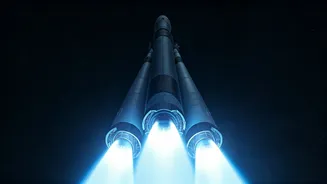






A Giant Leap Forward
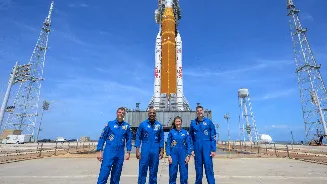
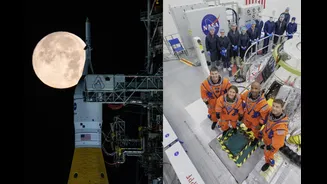
NASA's Space Launch System (SLS) is poised to achieve a remarkable feat with the Artemis II mission, sending humans beyond Earth's orbit toward the Moon.
This flight is extraordinary because it represents only the second launch of the SLS rocket, and its first with a human crew. Following the successful uncrewed Artemis I mission in November 2022, which saw the Orion spacecraft complete a lunar orbit and return, NASA has expressed high confidence in the rocket's performance. Artemis I provided a wealth of engineering data, confirming that the SLS core stage, engines, boosters, avionics, and software largely met or exceeded expectations, despite encountering some initial challenges that have since been addressed. This foundational success is what propels NASA forward into this crewed flight, aiming to re-establish human lunar presence for the first time since the Apollo era.
Crewed Mission, Critical Tests
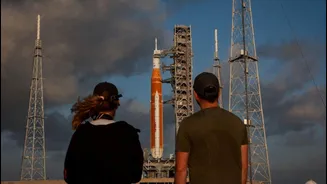
Despite carrying astronauts, Artemis II is fundamentally a test flight, meticulously designed to gather essential data for subsequent lunar landing endeavors, particularly Artemis IV. Over approximately ten days, the crew will rigorously evaluate the Orion spacecraft and SLS systems while operating in the deep space environment. This includes a flyby of the Moon and a safe return to Earth, all aimed at ensuring the reliability of these complex systems far from home. The SLS itself is positioned as a vital national asset, uniquely capable of transporting crews and substantial exploration payloads directly to the Moon in a single launch. Towering over 98 meters and generating a colossal 8.8 million pounds of thrust, powered by a core stage with roots in space shuttle technology, the SLS stands as the most potent rocket ever to have flown, though its power must be coupled with absolute reliability.
Streamlining for Safety
NASA has adapted its pre-launch testing philosophy for Artemis II, incorporating lessons learned from Artemis I to optimize the mission's readiness. The agency has reduced the number of integrated pre-flight tests, viewing these modifications as calculated risk-reduction measures. These changes are supported by extensive data analysis from Artemis I, which yielded over four terabytes of onboard telemetry and 31 terabytes of imagery, crucial for understanding the rocket's behavior throughout its flight. For Artemis II, specific design updates have been implemented, including refined software, upgraded power distribution units, structural modifications to mitigate vibrations, and enhancements to quick-disconnect systems to minimize leak potential. The wet dress rehearsal, involving the loading and unloading of cryogenic propellants, now serves as the final major system validation before launch, reflecting a more efficient yet thorough approach.
An Unprecedented Trajectory
Artemis II represents a modern deep-space exploration reality: a human mission utilizing a rocket with a very limited flight history. In contrast to the Saturn V rocket, which underwent two uncrewed flights before carrying astronauts on Apollo 8, the SLS is progressing from a single uncrewed mission directly to a crewed lunar flyby. NASA emphasizes that the SLS is engineered for human safety, boasting extensive ground testing, heritage engines, and integrated abort systems. The Artemis II configuration maintains the Block 1 architecture used in Artemis I, with mission-specific enhancements rather than an entirely new vehicle. The core stage, five-segment solid rocket boosters, and RS-25 engines, all with proven histories from the Space Shuttle program, form the rocket's robust foundation. NASA contends that the SLS is not experimental but a carefully integrated system composed of components with decades of reliable performance.
Balancing Risk and Ambition
The Artemis II mission prompts a fundamental question about the sufficient level of testing before human flights, especially when viewed against global space exploration strategies. India's Gaganyaan program, for instance, adopts a more gradual approach, planning at least three uncrewed flights of its human-rated Launch Vehicle Mark-3 before committing astronauts to orbit. These missions are designed to progressively validate systems under actual flight conditions. NASA's Artemis strategy, conversely, reflects a different rationale, influenced by established hardware, comprehensive ground validation, and the imperative to re-establish human presence beyond Earth orbit. The agency consistently highlights that Artemis II is not intended to showcase perfection but rather to identify, understand, and manage risks before committing to lunar landing missions. In essence, Artemis II serves as both a historic voyage and a significant systems-engineering experiment, preparing for the ambitious goal of landing humans on the Moon.