





Naval Force Assembled
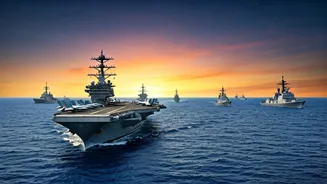
In late January, a formidable US naval contingent, including the colossal aircraft carrier USS Abraham Lincoln and three guided-missile destroyers—USS
Frank E. Petersen Jr, USS Michael Murphy, and USS Spruance—was strategically positioned in the Arabian Sea. This deployment was a direct response to escalating tensions with Iran, with President Donald Trump emphasizing the "very big, very powerful" nature of the deployed assets, while expressing a hope that they would not be necessary. The carrier group’s transit was visibly publicized by the US military, showcasing aircraft in flight over the Arabian Sea with a message of "Peace through Strength!" This naval might is further augmented by an additional roughly 5,700 service members who joined the existing forces. The presence extends to littoral combat ships like the USS Santa Barbara, USS Canberra, and USS Tulsa, positioned within the Persian Gulf, equipped to counter potential Iranian mine-laying operations. Another guided-missile destroyer, the USS Delbert D. Black, was observed traversing the Suez Canal from the Mediterranean to the Red Sea, indicating a broad regional strategic posture.
Air Power Deployed
Complementing the naval buildup, the US Air Force has also enhanced its regional presence with the introduction of F-15E Strike Eagle fighter jets to the Middle East. This deployment is intended to bolster combat readiness and promote regional security and stability, as announced by the US Central Command. Further bolstering air capabilities, a significant influx of aircraft arrived at Muwaffaq Salti Air Base in Jordan. This included a dozen F-15 fighter jets, an MQ-9 Reaper combat drone, and several A-10C Thunderbolt II ground attack aircraft. These additions significantly increase the US's air-superiority and ground-attack capabilities in the region. The UK has also contributed to the air defense posture by deploying Typhoon fighter jets to Qatar, ostensibly for defensive purposes. Surveillance and reconnaissance capabilities have also been strengthened, with reports of a US Navy MQ-4C Triton surveillance drone operating over the Gulf, alongside other specialized aircraft such as an E-11A communications aircraft, a P-8 Poseidon, and E-3G Sentry surveillance and reconnaissance planes.
Air Defense Fortified
In addition to offensive and surveillance assets, the United States has reinforced its defensive posture in the region with advanced air defense systems. Terminal High Altitude Area Defence (THAAD) systems and Patriot missile systems have been stationed at Al Udeid Air Base in Qatar, a move that mirrors past US deployments in anticipation of potential Iranian retaliatory strikes, such as the missile barrage targeting Al Udeid Air Base following strikes on nuclear sites. This proactive air defense strategy is crucial for protecting US assets and allies from ballistic missile threats. The US Department of Transportation's Maritime Administration has also issued updated guidance for commercial vessels transiting the Strait of Hormuz, a vital oil shipping lane. The advice urges US-flagged vessels to maintain maximum distance from Iran's territorial waters and to refuse boarding requests, underscoring the heightened risk and the importance of navigational vigilance amidst simmering tensions over Iran's nuclear program and ballistic missile development.