





Bridging the Gap
The Mumbai-Pune Expressway, a critical route for Maharashtra, is undergoing a major transformation with the imminent completion of its "Missing Link."
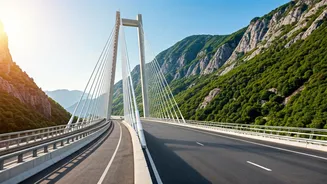
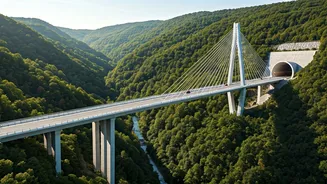
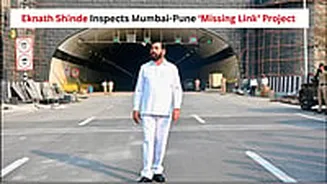
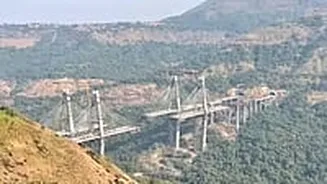
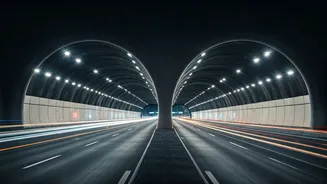
This 13.3-kilometer section, designed to bypass the challenging ghat section, incorporates India's longest twin-tube road tunnel. Constructed at a substantial investment of Rs 8,000 crore, this engineering marvel promises to shave off considerable travel time, particularly alleviating congestion that frequently plagues the ghat areas, especially during adverse monsoon conditions. The existing 19-kilometer stretch from Khopoli exit to Sinhgad Institute will effectively be shortened by approximately six kilometers, offering a more direct and efficient passage. This reduction in distance, coupled with the elimination of sharp curves, is expected to contribute to a travel time saving of about 20-25 minutes for motorists traversing between these two major metropolises. The project is strategically divided into two packages, with Package-I featuring twin tunnels of 1.75 km and 8.92 km, and Package-II encompassing two eight-lane viaducts measuring 790 meters and 650 meters respectively, showcasing the scale of this infrastructure endeavor.
Engineered for Safety
Beyond reducing travel duration, the 'Missing Link' places a strong emphasis on traveler security. Discussions are ongoing regarding potential adjustments to the speed limits, which currently stand at 100 kmph for light motor vehicles and 80 kmph for heavy vehicles. The advanced infrastructure, particularly the tunnel, may warrant a revised speed regulation. To bolster safety, the Maharashtra Highway Police are implementing a comprehensive suite of advanced surveillance systems, including speed cameras, and a robust emergency response framework. The 1.7-kilometer twin-tube tunnel itself is a testament to modern engineering, equipped with cutting-edge safety features such as fire detection and suppression systems, efficient ventilation, and accessible emergency exits. Each corridor of the Missing Link boasts four lanes plus an additional shoulder lane, an upgrade from the expressway's standard three lanes, allowing for better traffic flow. Notably, vehicle stoppages are prohibited on this new stretch, mirroring the expressway's policy. The inclusion of sophisticated Intelligent Traffic Management Systems (ITMS) with AI-enabled cameras, already operational on the existing expressway, will also be deployed here to monitor speed limit and lane discipline violations, with challans issued accordingly. Water sprinklers, fire detection, and alarm systems are integrated within the tunnels.
Command Center Operations
A sophisticated 24x7 emergency and enforcement nerve center has been established to manage the 'Missing Link.' This critical hub comprises twin multi-agency control rooms situated near the tunnel's endpoints. These centers are staffed around the clock by personnel from the Highway Police, MSRDC (Maharashtra State Road Development Corporation), and the RTO (Regional Transport Office). Real-time visual surveillance is provided by numerous Pan-Tilt-Zoom (PTZ) CCTV cameras strategically placed along the entire stretch. In the event of any incident, such as vehicle stoppages, accidents, or fires, the control room personnel are equipped to initiate immediate response protocols. This involves dispatching the appropriate emergency services, including patrolling vehicles, ambulances, fire tenders, and cranes. The control rooms have the capability to direct response vehicles through the opposite tunnel corridor via connecting passages, ensuring swift access to incident sites. Furthermore, SOS panic buttons are installed every 250 meters along the 'Missing Link,' providing a direct channel for users to summon assistance. These calls are also managed by the control room. For speed violation detection, specialized vehicles equipped with speed guns will be positioned at the ends of the 'Missing Link.' It is anticipated that this new segment will handle over 70% of the traffic, initially comprising cars, passenger buses, and passenger vehicles.
Operational Phases
The access and speed limit regulations for the 'Missing Link' have been officially notified. For the initial phase, spanning from May 1st to October 31st, only Light Motor Vehicles, passenger buses, and passenger vehicles are permitted. Heavy vehicles, such as goods vehicles, may be allowed to use the 'Missing Link' from November 1st onwards, following a comprehensive review of the first six months of operation. However, a complete prohibition will remain in effect for vehicles transporting hazardous materials, including flammable and explosive substances; these will continue to utilize the existing expressway. The designated speed limit for cars and Light Motor Vehicles is set at 100 kmph. For passenger vehicles and passenger buses, the speed limit will be 80 kmph. These speed limits are consistent with those on the existing expressway, excluding the ghat section. The division of traffic management responsibilities is clear: the approximately nine-kilometer-long first major tunnel falls under the jurisdiction of the Khandala Traffic Aid Posts (TAP) within the Pune division of the Highway Traffic Police. Subsequent infrastructure, including a valley bridge, a shorter tunnel, and the link to the expressway, is managed by the Borghat TAP, which is part of the Raigad division of the Highway Traffic Police. Both the Pune and Raigad Divisions will deploy approximately 15 personnel each for traffic rule enforcement and emergency response coordination.