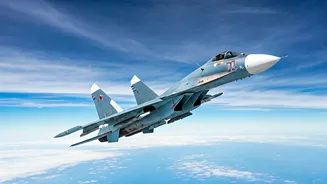

Checkmate's Debut Flight
The Su-75 Checkmate, Russia's cutting-edge fighter jet, recently completed its first flight, representing a pivotal moment in global aerospace developments.
This single-engine, stealth fighter is designed to be highly maneuverable, incorporating advanced avionics and a range of sophisticated weaponry. The aircraft’s design emphasizes low radar cross-section technology, making it harder to detect by enemy radar systems. The Checkmate's introduction showcases Russia's commitment to advancing its military aviation capabilities and enhancing its global presence within the aerospace sector. This first flight is a testament to the engineering and technological expertise that went into the development of the Su-75.
Key Features Explored
The Su-75 Checkmate boasts several advanced features, signifying a leap forward in fighter jet technology. The aircraft is designed with a modular architecture, enabling it to be adapted for diverse mission profiles, ranging from air-to-air combat to ground attack operations. It is equipped with a modern AESA (Active Electronically Scanned Array) radar system, which offers enhanced detection and tracking capabilities, ensuring the pilot has superior situational awareness. Furthermore, the Checkmate is expected to have a high degree of digital integration, potentially increasing the pilot’s ability to efficiently manage multiple systems and make tactical decisions. The integration of advanced electronic warfare systems is intended to enhance survivability, allowing the aircraft to operate in contested environments and withstand sophisticated threats.
India's Interest Unveiled
India's potential interest in acquiring the Su-75 Checkmate has sparked significant discussion within defense circles. This consideration can be attributed to several factors. The Checkmate's advanced technology and operational capabilities could offer a substantial enhancement to the Indian Air Force's combat capabilities, helping to modernize its fleet. The possibility of acquiring such an advanced aircraft is also seen as a strategic move, allowing India to strengthen its ties with Russia. This could lead to collaborative opportunities in defense technology and joint ventures, supporting India's ambition for self-reliance in defense manufacturing. The decision to potentially purchase the Su-75 reflects India’s ongoing efforts to update its military hardware, ensuring it remains prepared to manage any potential regional security challenges.
Strategic Implications Examined
The acquisition of the Su-75 Checkmate could bring about substantial strategic implications for India and the larger regional dynamics. This would enhance India's air power, providing an advantage in various scenarios, and could influence the balance of power within the region. The purchase could also impact India's relationships with other nations and influence the way they perceive its defensive capabilities. The integration of the Checkmate into the Indian Air Force is likely to demand significant changes to existing infrastructure, and it might call for training programs for pilots and maintenance personnel. The decision could also affect the country’s existing agreements and partnerships in defense and lead to further collaborations with Russia and other partners.
Comparative Analysis Undertaken
Comparing the Su-75 Checkmate with existing fighter jets will allow for a better understanding of its strengths and weaknesses. The Checkmate is a fifth-generation fighter jet, designed to rival aircraft of the same generation. However, it's essential to assess its performance in terms of speed, range, maneuverability, and stealth characteristics, and compare these metrics against its competitors. Consideration must be given to the aircraft's avionics, weapons systems, and the level of integration with its supporting infrastructure. Such comparisons allow defense analysts and policymakers to make more informed decisions when choosing which aircraft will meet their requirements. The analysis provides an important insight into the overall value proposition of the Su-75, and its suitability for India’s unique security needs.
Future Prospects Considered
The long-term prospects surrounding the Su-75 Checkmate and India's potential acquisition will likely determine the future of air combat capabilities in the region. Should India finalize an agreement, the integration process would be a complex undertaking, involving technology transfer, infrastructure updates, and extensive pilot and ground crew training. The success of the Checkmate program may depend on technological advancements, upgrades, and effective operational deployment. Furthermore, the strategic environment, global politics, and India’s relationship with its neighbors will play pivotal roles in influencing the direction of the Checkmate program, and its long-term viability in the context of the Indian Air Force.