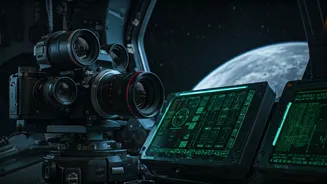








Advanced Camera Arsenal
The Artemis II mission revolutionizes space photography by equipping astronauts with a sophisticated array of 28 cameras, both inside and outside the Orion
spacecraft. This diverse setup ensures comprehensive documentation of every mission phase. For capturing high-detail scientific and technical imagery, the crew utilizes professional-grade DSLR and mirrorless cameras, specifically the Nikon D5 and Nikon Z9 models. To document dynamic events and wide-angle perspectives, such as internal activities or external views, durable GoPro HERO4 Black cameras are employed. Notably, this mission marks a significant milestone with the unprecedented approval of personal smartphones for use in lunar exploration. Astronauts are leveraging the capabilities of the iPhone 17 Pro Max to capture intimate, high-quality photographs of Earth as seen through the spacecraft's windows. These consumer devices underwent a stringent, four-phase vetting process to guarantee their safety and reliability in the challenging microgravity environment, addressing concerns related to heat dissipation and battery stability without posing any operational hazards.
Laser-Fast Communication
Unlike the often lengthy delays in image dissemination during past lunar missions, such as the Apollo era, the Artemis II mission is employing a groundbreaking communication system to transmit visuals almost instantaneously. The Orion spacecraft is equipped with the Orion Artemis II Optical Communications (O2O) system, which utilizes infrared lasers instead of traditional radio waves. This advanced laser beaming technology facilitates data transmission at impressive speeds of up to 260 megabits per second. This allows the crew to beam back high-resolution content, including 4K video footage and detailed still images, from lunar distances with remarkable immediacy. This near real-time capability dramatically enhances the mission's ability to share its discoveries and awe-inspiring views with the world, bridging the gap between space exploration and public engagement.
Mission Visual Priorities
During their historic lunar flyby on April 6, 2026, the Artemis II astronauts have a focused set of visual objectives designed to expand our understanding and appreciation of space. A primary focus is the observation and high-resolution photography of the Moon’s far side, specifically targeting crater edges, intricate ridges, and ancient lava flows in regions that have never been directly viewed by human eyes. Furthermore, the crew is dedicated to capturing profound 'deep-space Earth views.' This includes documenting the transformative 'overview effect' experienced by astronauts, showcasing images that highlight the Earth’s terminator line, the illuminated patterns of city lights across continents, and the breathtaking spectacle of vivid auroras. Complementing these are critical technical observations. Astronauts are utilizing three Nikon cameras, equipped with various zoom lenses, to provide crucial visual data that will assist scientists at NASA’s Johnson Space Center with detailed geological analysis of celestial bodies.