





A Galaxy's Demise
Pablo's Galaxy's story begins with its tragic end, sparking the curiosity of astronomers around the globe. The initial question was: what could possibly
cause the ultimate demise of a galaxy? Several possibilities were considered by the scientists, including a catastrophic, high-speed collision with another celestial body. Such a destructive event could rip a galaxy apart, scattering its stars and gas across the cosmos. This violent scenario raised questions about the dynamics of galaxies, what sort of events could trigger it, and the observable signs it would leave behind. The focus shifted toward understanding whether a galactic collision marked Pablo's Galaxy's last stand.
Webb and ALMA's Findings
The James Webb Space Telescope (JWST) and the Atacama Large Millimeter/submillimeter Array (ALMA) played crucial roles in this cosmic investigation, offering unparalleled views of Pablo's Galaxy. The JWST's capacity to observe in infrared light provided unique perspectives on the galaxy's core, penetrating through the dust and revealing previously hidden details. ALMA, on the other hand, focused on the emission of radio waves, allowing astronomers to see the distribution of cold gas and dust in the galaxy. Combining data from both observatories offered a comprehensive picture of Pablo's Galaxy's structure, composition, and dynamics before its ultimate end. These findings were crucial for astronomers to determine what was causing the galaxy's demise, and it offered clues for what the fate of the galaxy was.
Collision or Slow Death?
The research teams looked at two potential causes of Pablo's Galaxy's untimely demise. One was a sudden collision, a violent event that could tear the galaxy apart in a dramatic explosion of energy and matter. If a collision did take place, it would have left behind clear, observable signs such as distorted shapes, tidal tails, and a burst of star formation. However, another theory suggested a slower, more insidious end: death by a thousand cuts. In this scenario, a supermassive black hole at the galaxy's center would gradually consume the galaxy's resources. The black hole's gravity would slowly pull in gas and dust, disrupting star formation and starving the galaxy from the inside. Astronomers used the data from Webb and ALMA to determine the galaxy's demise, if it was sudden, or slow.
Black Hole's Deadly Role
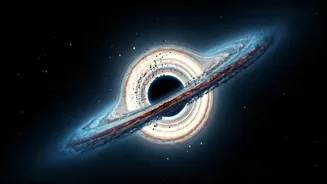
The presence and impact of a supermassive black hole at the center of Pablo's Galaxy provided insights into the galaxy's fate. Black holes are known for their strong gravitational pull. As material falls into a black hole, it forms a disk of superheated gas and dust, a process that emits intense radiation that could disrupt star formation and heat the surrounding galaxy. According to the observations made by the James Webb Telescope, the galaxy seemed to be in a dying phase. The data also helped astronomers understand how the supermassive black hole at the center of the galaxy contributed to this demise. It revealed a process where the black hole was steadily consuming the galaxy from within, leading to its eventual and inevitable disintegration.
Unveiling the Mystery
The combined data from the Webb Telescope and ALMA painted a detailed picture of what happened to Pablo's Galaxy. The observations did not reveal any clear evidence of a catastrophic collision, such as distorted shapes, which pointed towards the second theory: the black hole. The telescope's observations showed signs of disruption, revealing that the supermassive black hole was responsible for the galaxy's destruction. The galaxy's gas and dust were being pulled towards the black hole, causing star formation to halt and the galaxy to slowly unravel. The research team was able to conclude that Pablo's Galaxy experienced a 'death by a thousand cuts,' which confirmed the significant role that a supermassive black hole can play in galactic evolution.