






Orbital Exit Imminent
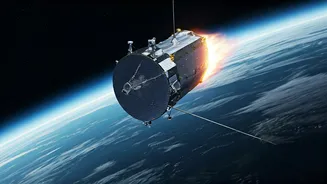
After an extensive 14-year tenure orbiting our planet, a NASA spacecraft, tipping the scales at a substantial 1,323 pounds, is on a course for re-entry
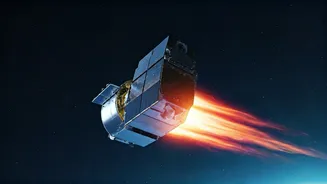
into Earth's atmosphere. This significant orbital resident is projected to make its return around 7:45 pm EDT on March 10th, according to estimations from the US Space Force. However, this prediction comes with a margin of error of approximately 24 hours, meaning the exact moment of re-entry could vary. NASA has confirmed that this descent will be an uncontrolled event, precluding any ability for engineers to guide its trajectory. The agency anticipates that the vast majority of the satellite will vaporize as it blazes through the atmospheric layers. Despite this, a small fraction of its components are expected to survive the intense heat, though the probability of any harm to individuals on the ground is remarkably low, calculated at about 1 in 4,200.
Scientific Legacy Unveiled
The re-entering spacecraft is none other than one of the Van Allen Probes, twin probes that embarked on a crucial mission from 2012 to 2019. Their primary objective was to navigate through the Van Allen belts, which are dynamic regions of charged particles held captive by Earth's magnetic field. By flying through these belts, the probes aimed to unravel the complex processes governing how these particles are both acquired and lost. This groundbreaking mission significantly enhanced our understanding of the behavior of Earth's radiation belts and the profound impact solar activity has on various technologies, including satellites, the safety of astronauts in space, and our global communication networks. The belts themselves play a vital role in shielding our planet from hazardous cosmic radiation, powerful solar storms, and the relentless solar wind, all of which pose threats to life and technological infrastructure.
Accelerated Descent Factors
Initially designed for a modest two-year operational lifespan, the Van Allen Probes impressively continued their data collection for nearly seven years before their mission concluded due to a depletion of fuel. This extended operational period provided invaluable insights into the protective shield that surrounds our planet. NASA had previously projected that the spacecraft would make its atmospheric re-entry around 2034. However, recent increases in solar activity have played a pivotal role in accelerating this process. Elevated solar activity leads to heightened atmospheric drag, essentially creating a stronger 'push' against the satellite in its orbit. This increased resistance has caused the spacecraft's orbit to decay at a pace much quicker than initially anticipated, bringing its fiery farewell forward by several years. In contrast, its twin, Van Allen Probe B, is expected to maintain its orbit for a considerably longer period, remaining aloft until at least 2030.
A Skyward Spectacle
For those fortunate enough to be observing the skies at the opportune moment, the re-entry of this substantial NASA satellite might present a visually striking phenomenon. Retired astrophysicist Jonathan McDowell shared with The New York Times that the descent could manifest as a brilliant streak of light, a fleeting celestial display for any lucky onlookers. He further offered reassurance to the general public, suggesting that for the average person, this event is likely to be a beautiful, albeit transient, visual experience in the night sky if one is in the right place at the right time. Otherwise, he advised, there is little cause for concern. The inevitable fall of defunct satellites and remnants of rocket launches is a recurring occurrence in space debris management, making such re-entries a relatively common, though always notable, event in the grand scheme of orbital mechanics.