








A Dual-Domain Marvel
India has officially introduced 'Avataar,' a revolutionary amphibious drone developed by the Bengaluru-based startup AquaAirX Autonomous Systems. This
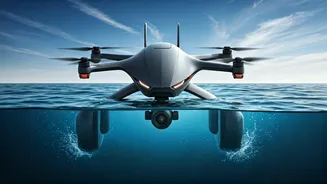
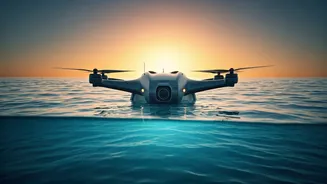
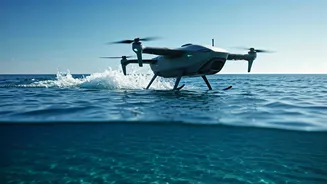
remarkable device is designed to transcend the limitations of traditional drones by operating effectively in both the aerial and underwater domains. Its creation signifies a substantial advancement in India's expertise in multi-domain robotics and surveillance technology. The drone's unique ability to fly like a standard unmanned aerial vehicle (UAV), then smoothly transition to land on water and subsequently dive deep for intricate missions, opens up a plethora of new operational possibilities. AquaAirX Autonomous Systems, the innovator behind Avataar, specializes in crafting autonomous vehicles for challenging environments, including oceans, rivers, and coastal regions, making this development a strategic asset for national security and scientific research.
Engineered for Harsh Environments
The Avataar drone is meticulously engineered to withstand the rigors of its dual operational environments. Its robust frame is constructed from saltwater-proof carbon fiber, ensuring exceptional resistance to corrosion, a critical feature for marine operations. Furthermore, the drone is equipped with specialized coatings designed to repel salt deposits and prevent the accumulation of sensor grime, maintaining operational efficiency even in harsh marine conditions. The developers have confirmed that Avataar has achieved Technology Readiness Level 6 (TRL 6), a crucial benchmark indicating that the technology has moved beyond laboratory prototypes and undergone successful testing in realistic, challenging aquatic environments, not just controlled tank simulations. This level of maturity signifies its readiness for advanced trials and potential mass production.
Autonomous Operation Unveiled
Avataar functions as an autonomous drone capable of navigating both the skies and underwater depths. Its design merges the agility of a multi-rotor copter for aerial reconnaissance with the resilience of an underwater vehicle. This enables it to perform tasks previously requiring multiple specialized machines. For entities like India's Navy and Coast Guard, this means a single drone can conduct aerial surveillance to identify vessels from above and then dive beneath the surface to inspect the hull or detect submerged threats. To maintain precise positioning amidst ocean currents, Avataar incorporates an intelligent speed and position monitoring system that references the seabed, ensuring accurate location awareness. Communication with the surface is facilitated through sound waves, functioning as an underwater equivalent of Wi-Fi, transmitting data without physical tethers. Its navigation system also includes a sophisticated timer that calculates distance and direction for autonomous return to its base.