





Launch Day Begins
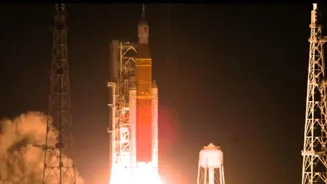
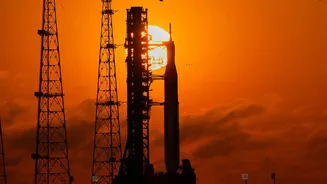
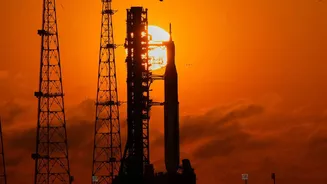
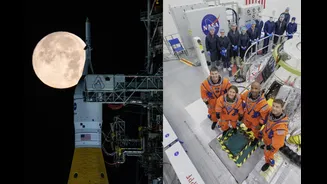
The Artemis II mission is set to commence with a powerful liftoff from Florida's Kennedy Space Center, utilizing the immense capabilities of the Space Launch
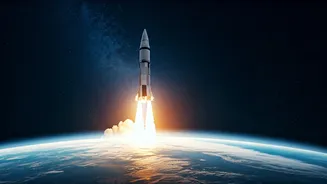
System rocket. NASA has identified April 1st as the opening of the launch window, with subsequent opportunities available if needed, dependent on factors like weather, system readiness, and operational clearances. Following its ascent, the Orion crew capsule will detach from the rocket's upper stage, positioning itself in a wide, elliptical orbit around our home planet, Earth, signifying the initial phase of this historic lunar endeavor.
Earth Orbit Checkouts
For the initial one to two days of the mission, the astronauts will remain in high Earth orbit, diligently performing comprehensive system verifications. This crucial period is dedicated to meticulously testing all of Orion's vital functions, including its life-support mechanisms, propulsion capabilities, navigation systems, and communication equipment. The primary goal is to guarantee that the spacecraft is in optimal condition and fully prepared for its journey into the deeper reaches of space, far beyond the familiar confines of Earth's orbit.
Translunar Injection Maneuver
Once all system checks in Earth orbit are successfully completed, the Orion spacecraft will execute a pivotal engine burn known as translunar injection. This critical maneuver is designed to propel the spacecraft out of its Earth-bound orbit and set it on a precise trajectory that will carry it all the way to the Moon, marking the definitive start of its outward journey into interplanetary space and signaling its departure from our planet's gravitational embrace.
Journey to the Moon
Over the subsequent several days, the crew will experience a coasting transit towards the Moon. During this period, the astronauts will maintain continuous monitoring of the spacecraft's systems as it travels farther from Earth than any human spaceflight mission has previously ventured. Mission control will closely observe the performance of communication and navigation systems, ensuring Orion maintains its course and operational integrity as it navigates the vast expanse of deep space en route to its lunar destination.
Lunar Flyby Phase
The Artemis II spacecraft will perform a flyby of the Moon, traversing a 'free-return' trajectory. This particular path is strategically chosen as it naturally guides the spacecraft back towards Earth without the necessity of expending additional propellant for course correction. It is during this phase of the mission that Orion will achieve its furthest point from Earth, showcasing the remarkable reach of human space exploration and the sophisticated orbital mechanics involved in lunar missions.
Return Journey Underway
Following the lunar flyby, the astronauts will embark on the multi-day journey back towards Earth. This return leg of the mission will not be idle; the crew will conduct further in-depth tests of various deep-space systems. These evaluations will encompass the performance of power systems, thermal control mechanisms, and overall crew operations, conducted in an environment significantly farther from Earth than what was experienced during the earlier stages of the mission.
Re-entry and Splashdown
As the Orion capsule approaches Earth, it will shed certain components before commencing its atmospheric re-entry, hitting the planet's atmosphere at an astounding speed of approximately 25,000 miles per hour. A paramount objective of Artemis II is to rigorously test the integrity and effectiveness of the capsule's heat shield during this high-energy re-entry phase. The mission is slated to conclude with a splashdown in the Pacific Ocean, where specialized recovery teams will be positioned to safely retrieve the crew and the spacecraft.