


A 'Cruel' Government
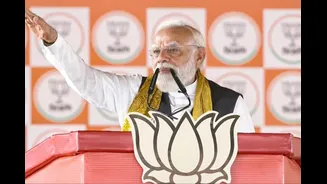
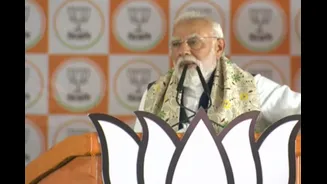
Prime Minister Narendra Modi has vehemently criticized the Trinamool Congress (TMC) government in West Bengal, labelling it a 'nirmam sarkaar,' which translates
to a 'cruel government.' Speaking at a rally in Haldia, he asserted that while the rest of India is advancing, the TMC's governance has hindered West Bengal's progress. He drew a parallel to the 2021 elections, recalling how Nandigram paved the way for change with BJP leader Suvendu Adhikari's victory over Chief Minister Mamata Banerjee. Modi expressed confidence that a similar 'miracle' would now occur in Bhabanipur, where both Adhikari and Banerjee are contesting, and would sweep across the entire state. He emphasized that this election is not merely a political contest but a crucial step towards reclaiming Bengal's lost glory and establishing a foundation for a developed state. The immediate priority, he stated, is to oust the current 'cruel' administration, highlighting its detrimental impact on West Bengal's trajectory.
Economic Stagnation and Misrule
During his address in Haldia, Prime Minister Modi painted a grim picture of West Bengal's economic landscape under TMC rule. He reminisced about Haldia's past as a vibrant port city attracting global trade, contrasting it with the current reality where factories bear 'locks' and local youth are compelled to seek employment in other states like Andaman and Odisha. Modi alleged that the TMC government has fostered an environment where 'infiltrators' and 'rioters and criminals' have thrived, while legitimate economic activity has languished. He accused the party of running a system of 'syndicates' where 'cut money' and commissions are prerequisites for any work to be done. This alleged corruption and neglect, Modi suggested, have deprived Bengal of vital central government schemes, exacerbating the state's developmental deficit and pushing it backward despite national progress.
Restoring Faith and Law
Prime Minister Modi addressed critical concerns regarding women's safety and the rule of law in West Bengal. He claimed that under TMC governance, women's safety has deteriorated significantly over the past 15 years, marked by an increase in crimes against women and a decline in punishment rates. He pledged that a BJP government would work to eradicate the pervasive 'fear' instilled by the TMC and re-establish citizens' trust in the legal system. Modi assured that his government would ensure accountability within the administrative structure. He also vowed to reopen cases related to corruption, scams, crimes against women, and rapes, stating that those found guilty, including ministers, would face imprisonment. He further clarified that while refugees would be granted their rights, 'infiltrators' would not be permitted to remain in India, aiming to restore order and fairness.
Development Through Double Engine
Modi articulated his vision for West Bengal's development, particularly focusing on sectors like fisheries and agriculture. He highlighted the immense potential of fish farming in regions like Medinipur, noting that despite high demand, the state remains dependent on other states for its fish supply. He cited examples from Bihar and Assam, where BJP policies have reportedly doubled fish production, making them self-sufficient and exporters. Modi stressed the necessity of a 'double-engine government' – a BJP government at both the Centre and the state – to facilitate the swift implementation of central schemes. He mentioned the creation of a dedicated fisheries ministry and insurance provisions for fishermen, promising benefits for potato and betel farmers once BJP assumes power, thereby fostering self-reliance and economic growth.
Bengal's Diminished Contribution
In his address in Asansol, Prime Minister Modi discussed the industrial decline of the region, once a major hub for various industries. He lamented the rise of a 'coal mafia' and 'sand mafia' that has burdened the area, forcing its youth to seek opportunities elsewhere. Modi contrasted the past, when West Bengal contributed significantly to India's national income (Rs 12 out of Rs 100 at independence), with the present, where its contribution has dwindled to merely Rs 5 out of Rs 100. He attributed this decline to the 'Congress and Left regimes' and, more recently, the 'cruelty' of the TMC government, which he claimed has impoverished the state while enriching TMC ministers and their associates. He asserted that West Bengal has placed its trust in various parties over time, only to be consistently 'cheated,' and declared that it is now time for genuine development.
Against 'Maha Jungle Raj'
Prime Minister Modi condemned the prevailing conditions in West Bengal, characterizing them as 'maha jungle raj.' He cited incidents like the attack on judicial officers in Malda as clear evidence of the breakdown of law and order, calling it the 'last nail in the coffin' for the TMC. He alleged that the TMC operates out of fear, resorting to abuses against central forces and attempting to obstruct the rule of law. Modi warned that the people of Bengal would deliver a decisive response. He also raised concerns about the changing demographics in certain areas due to infiltrators, leading to restrictions on religious practices for the local population. He accused the TMC of creating a divisive atmosphere, similar to historical threats against Hindus, by allegedly intimidating one community based on the other.