
A Rare Celestial Sight
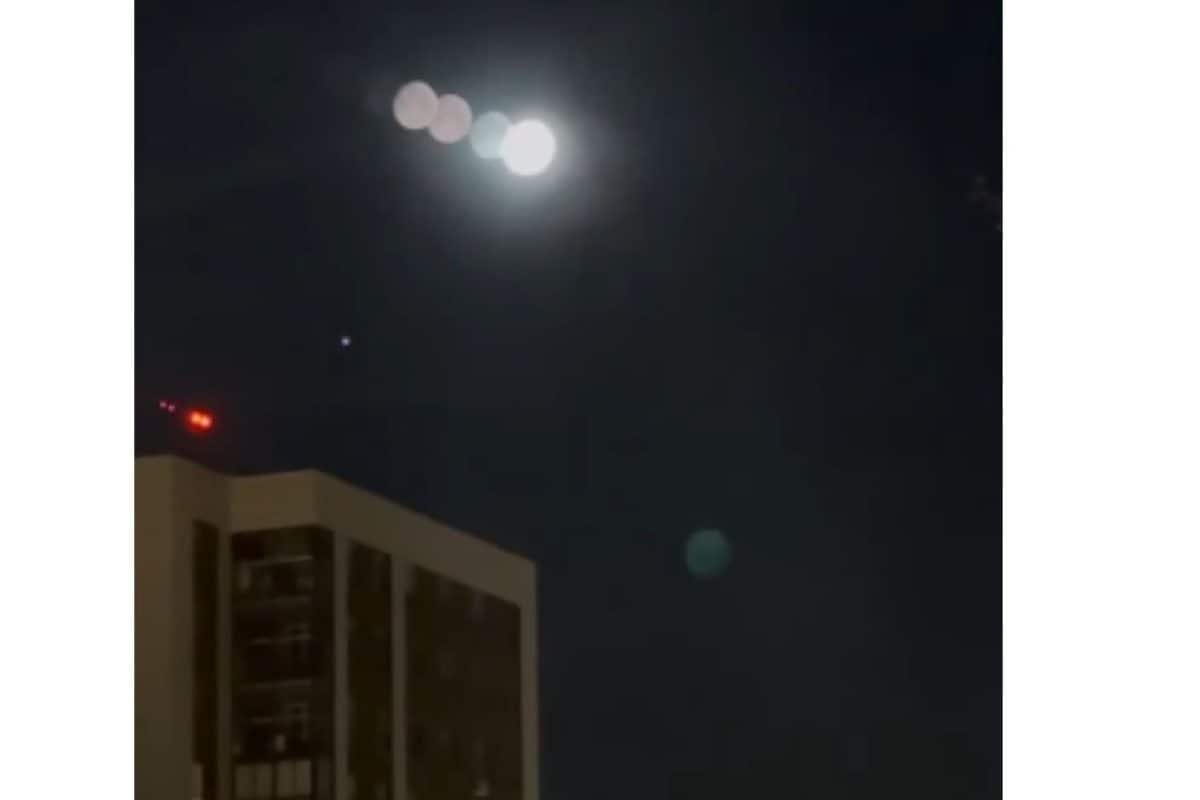
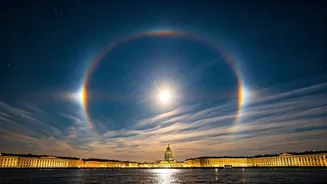
The residents of St. Petersburg experienced an uncommon spectacle when they saw four moons illuminating the night sky. This exceptional event, capturing
the attention of stargazers, proved to be a paraselenae, more commonly recognized as a moon dog or a mock moon. This intriguing phenomenon is generated when moonlight interacts with ice crystals that are plate-shaped and hexagonal in cirrus clouds situated high in the atmosphere. The display provided a unique and memorable astronomical event for the local observers. This kind of event reminds us of the beautiful and unpredictable events that can happen in the vast space above us.
Understanding Paraselenae Formation
Paraselenae are created through a captivating process involving the refraction of moonlight. This phenomenon occurs when moonlight passes through thin ice crystals that are hexagonal and plate-shaped, which are typically found in high cirrus clouds. As the moonlight interacts with these ice crystals, it bends and changes direction. The refraction creates the illusion of additional moons. According to NASA, these mock moons are typically observed at an angle of 22 degrees or greater from the actual Moon. The vertical size of the paraselenae can vary and depends on the movement of the ice crystals, with larger crystals often resulting in taller and more pronounced mock moons.
The Science Behind the Show
The occurrence of paraselenae provides an insight into how light interacts with matter in the atmosphere. The shape and orientation of the ice crystals play a crucial role in creating this optical illusion. The hexagonal form of the ice crystals is particularly effective at refracting moonlight at specific angles. The elevation of the paraselenae mirrors the Moon's position relative to the horizon. Furthermore, the wobbling movement of the ice crystals has a direct impact on the vertical dimension of the resulting mock moons; bigger crystals produce more elongated displays. This rare sky phenomenon offers a chance to observe the complex interplay of atmospheric conditions and celestial light, offering a fascinating visual treat for observers.