





The Veena's Legacy
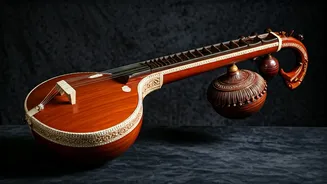
The veena, considered one of India's oldest stringed instruments, boasts a rich history. Its roots can be traced back to ancient times, with mentions in early
Hindu scriptures, symbolizing knowledge and the arts. The veena features a long, hollow neck and a large resonator, which amplifies its delicate tones. The instrument typically has four main strings for melody and three drone strings for creating a harmonic background. Different veena styles have evolved regionally, each contributing to the instrument's diverse character. The veena's elegant sound has long been central to classical Indian music, and it continues to inspire musicians today.
The Sitar's Ascent
The sitar, a crucial instrument in Hindustani classical music, is renowned for its enchanting and resonant qualities. Originating in the medieval period, the sitar's design is a blend of Persian and Indian influences. The sitar generally has a long neck, a gourd-shaped body, and a series of resonating strings alongside the playing strings. Skilled sitar players employ techniques like 'meend' (pulling strings to alter pitch) and 'gamak' (ornamentation) to produce a spectrum of musical expressiveness. Over the centuries, the sitar has evolved into a symbol of Indian musical identity and has garnered global acclaim through artists like Ravi Shankar.
Tabla's Rhythms Begin
The tabla, a pair of hand drums, is the rhythmic heart of Hindustani classical music, delivering complex rhythmic patterns and improvisations. The tabla consists of two drums: the 'dahina' (right-hand drum) and the 'bayan' (left-hand drum). The dahina is generally made of wood, while the bayan may be metal. Skilled tabla players use a range of hand strokes to produce a variety of sounds. The tabla is critical for setting the tempo and accentuating the melodic aspects of Indian music, with different 'gharanas' (schools of playing) contributing to its diverse artistry. The tabla continues to be a crucial element in contemporary musical compositions across diverse genres.
Flute's Melodic Grace
The bansuri, or bamboo flute, embodies the simple elegance of Indian folk and classical music. Traditionally made from bamboo, the bansuri's sound is produced by blowing across the open hole near one end. Its simple design enables players to achieve remarkable melodic expressiveness, with notes created by covering and uncovering the finger holes. Different types of bansuris exist, each crafted to fit various scales and musical styles. The bansuri is frequently associated with the pastoral settings in Indian culture and has featured prominently in devotional, folk, and classical music traditions, capturing tranquil and meditative soundscapes.
The Shehnai's Voice
The shehnai, a double-reed wind instrument, possesses a robust and auspicious sound, often used at ceremonies and festive occasions. The shehnai's structure is similar to the oboe, made of wood, with a conical bore and a flared bell. Its clear and penetrating tone is produced by blowing through a double reed. The shehnai is used frequently in wedding celebrations and temple music, representing the rich celebratory spirit of Indian culture. Despite its presence in traditional settings, the shehnai has crossed over into contemporary music.
The Santoor's Echo
The santoor, a trapezoidal hammered dulcimer, produces a bright and shimmering sound and is associated with the Sufi traditions of Kashmir. Originating in Persia, it has gained a special place in Hindustani classical music. The santoor features numerous strings that are struck with small wooden mallets, which offers rapid and complex melodies. The santoor is recognized for its unique sound, creating evocative and serene soundscapes. The instrument is a reflection of cultural exchange, merging Persian and Indian musical practices, and is still an important part of both instrumental and vocal performances.
The Harmonium's Arrival
The harmonium, a free-reed keyboard instrument, has found popularity in India, providing a versatile accompaniment for vocal and instrumental music. Introduced by European traders, the harmonium has been modified and localized to suit Indian musical practices. The instrument is operated by pumping air through a bellows to cause the reeds to vibrate, producing a sustained sound. The harmonium is an essential instrument in various musical forms, from classical to devotional music, and its adaptability makes it a favorite among musicians across India. Its ability to create rich, harmonious textures has cemented its place in Indian music.