




Historic Lunar Voyage
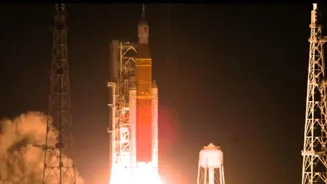
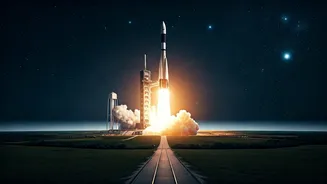
The Artemis II mission is scheduled to commence its celestial journey on April 1st from the Kennedy Space Center, ushering in a new chapter for human space
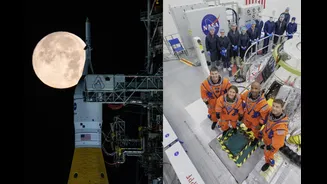
exploration. This pivotal mission represents the inaugural crewed flight within NASA's ambitious Artemis program. A team of four astronauts will embark on an expedition lasting roughly 10 days, venturing around the Moon. Significantly, this endeavor signifies the first instance of humans venturing beyond Earth's low orbit since the conclusion of the Apollo program, a monumental step that reawakens the spirit of deep-space pioneering. The crew comprises experienced NASA astronauts Reid Wiseman, Victor Glover, and Christina Koch, joined by Jeremy Hansen from the Canadian Space Agency, forming an international contingent ready to push the boundaries of human reach.
Orion and SLS Synergy
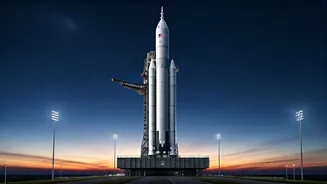
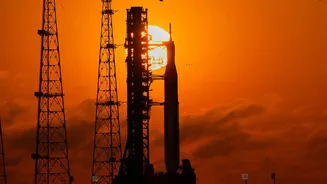
The Artemis II mission will launch aboard NASA's formidable Space Launch System (SLS) rocket, a powerhouse designed for deep-space missions. This powerful vehicle will propel the Orion spacecraft, carrying its human occupants, on their lunar trajectory. A crucial objective of this flight is to rigorously test Orion's life-support systems with astronauts onboard for the very first time. This human-rated testing is paramount for ensuring the safety and functionality of the spacecraft for extended missions into the cosmos. The SLS rocket and Orion spacecraft together represent the cutting edge of NASA's capabilities, designed to support crewed missions to the Moon and beyond, forming the backbone of future endeavors.
Favorable Launch Conditions
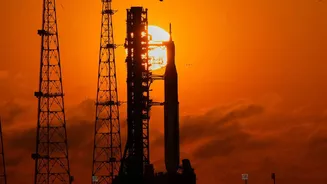
NASA has indicated that the meteorological forecast for the Artemis II launch day appears promising, with an estimated 80% probability of suitable conditions for liftoff. While the outlook is generally positive, potential challenges such as cloud cover and strong winds could influence the precise launch window. Mission planners have meticulously considered these variables to maximize the chances of a successful and safe departure. The agency is committed to providing continuous updates and coverage of the launch and the subsequent mission through its official communication channels, ensuring the public can follow every moment of this historic event.
Journey and Trajectory
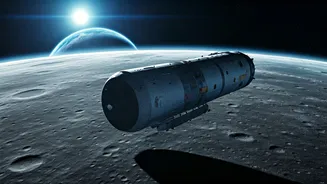
Following its ascent, the Artemis II spacecraft will initially navigate into a high Earth orbit before setting its course towards the Moon. The mission will utilize a 'free-return trajectory,' a carefully calculated path that will guide the spacecraft around the far side of the Moon and back towards Earth. This ingenious trajectory minimizes the need for propulsion during the return journey, demonstrating an efficient approach to deep-space navigation. During this expedition, the crew is anticipated to set a new record for the greatest distance ever traveled by humans from Earth, surpassing the previous mark established during the Apollo 13 mission, further highlighting the ambitious scope of Artemis II.
System Testing & Future Goals
The Artemis II mission serves as a critical proving ground for a suite of essential deep-space technologies and operational procedures. Among the key systems to be validated are emergency protocols, ensuring astronaut safety in unforeseen circumstances, and advanced radiation protection measures, vital for venturing beyond Earth's protective magnetosphere. Furthermore, the mission will evaluate next-generation communication technologies, including innovative laser-based data transmission systems, which promise significantly faster and more robust communication links with future deep-space explorers. These tests are indispensable stepping stones toward NASA's overarching objectives, including sustained human presence on the Moon and eventual crewed expeditions to Mars.