




An Unexpected Lunar Leap
India's Chandrayaan-3 mission, a landmark achievement in lunar exploration, continued to surprise long after its primary objectives were met. Towards the
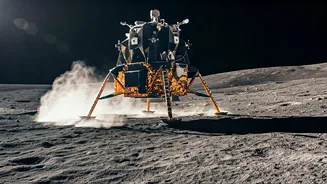
end of its operational period in 2023, the Vikram lander executed an unplanned 'hop' maneuver. This spontaneous decision, driven by the presence of residual fuel, transformed a simple technological demonstration into a significant scientific experiment. Originally designed to prove India's capability for safe lunar landings, the mission's success was amplified when the lander was commanded to lift off from its touchdown site near the Moon's South Pole. This brief ascent, propelling the lander approximately 40 to 50 centimeters into the lunar sky before a gentle re-landing, provided a unique opportunity to study a previously untouched patch of the lunar surface. The implications of this impromptu action extend beyond proving India's advanced lunar capabilities, such as the potential for future sample return missions, and have opened new avenues for understanding the intricate geological makeup of the Moon.
Peeling Back Lunar Layers
The strategic repositioning of the Vikram lander via its hop experiment allowed for a deeper scientific investigation of the lunar regolith, the loose surface material on the Moon. By moving to a fresh location, the Chandra's Surface Thermophysical Experiment (ChaSTE) payload could collect data from a new area. This was particularly valuable because the lunar South Polar region remains largely unexplored, with no prior human or robotic missions having directly sampled its surface. The act of firing the lander's engines also served to disturb the regolith. The rocket exhaust effectively cleared away the uppermost, loose layer of lunar dust, which scientists describe as a porous and somewhat 'fluffy' coating. Beneath this disturbed surface, ChaSTE was able to access and analyze material that had not been directly exposed to the harsh lunar environment or the vacuum of space. This exposure of underlying layers yielded critical data about the Moon's soil composition, challenging previous assumptions of uniformity.
Diverse Soil, New Realities
The data gathered by the ChaSTE instrument after the Vikram lander's hop revealed a striking picture of heterogeneity in the lunar soil at the Shiv Shakti Point. Contrary to expectations of a uniform surface, the regolith was found to be distinctly layered, resembling a cake with different strata. The top few centimeters were characterized by loose, highly porous material, while the layer directly beneath exhibited significantly different properties, being more dense and compact. This rapid transition in physical characteristics over a mere few centimeters highlights the complex and variable nature of the lunar South Pole's surface. Such significant variations in physical properties over short distances have crucial implications for future lunar endeavors. Missions planning to drill, excavate, or construct facilities on the Moon will need to account for this variability, necessitating precise, localized measurements rather than relying on generalized assumptions about lunar terrain.
Twilight Insights and Future Bases
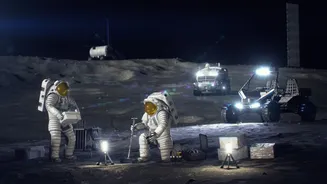
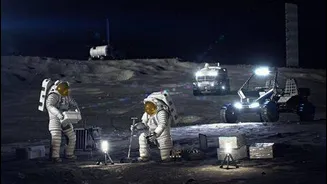
Beyond the immediate discovery of layered soil, the Chandrayaan-3 hop experiment also provided valuable observations during lunar twilight. This prolonged period of transition between day and night on the Moon allowed scientists to monitor how the regolith cools and dissipates heat in real-time. Understanding these thermal dynamics is essential, especially given the international focus on the lunar South Pole, largely driven by NASA's Artemis program. This region is of particular interest due to the potential presence of water ice in permanently shadowed craters, making it a strategic location for future lunar bases. The ChaSTE's measurements, offering insights into the thermophysical and geotechnical properties of the regolith, are fundamental for planning such ambitious projects. The confirmed variability of the lunar soil underscores the need for detailed, site-specific data to ensure the safety and feasibility of landing, construction, and exploration activities for future astronauts.