



The Need for Speed
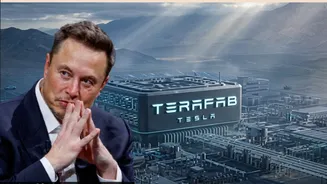
Elon Musk is embarking on a significant undertaking to establish a vast chip manufacturing plant, codenamed 'Tera-fab,' primarily to serve the escalating
requirements of his artificial intelligence (AI), robotics, and autonomous systems across his prominent companies, including Tesla and xAI. This strategic move is a direct response to a critical shortage of specialized semiconductors, a bottleneck that threatens to impede the rapid advancement of his compute-intensive AI and robotics initiatives. The goal is to achieve a degree of self-sufficiency, reducing dependence on external suppliers and ensuring that the pace of innovation is not dictated by external chip availability. Musk's vision extends beyond terrestrial applications, encompassing the development of advanced computational power for orbital data centers as well, highlighting a comprehensive approach to building a robust AI infrastructure across multiple domains.
Tera-fab's Strategic Location
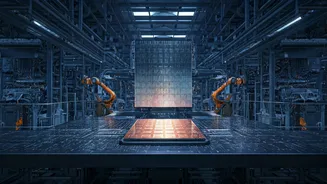
The proposed 'Tera-fab' facility is slated for construction in close proximity to Tesla's current headquarters and its sprawling Gigafactory in Austin, Texas. This strategic positioning is intended to foster synergy and streamline operations, allowing for a more integrated approach to chip production and its subsequent integration into vehicles and robots. This ambitious fabrication plant will be a collaborative effort, jointly managed by Tesla and SpaceX, two of Musk's most prominent ventures. The facility is envisioned as an 'advanced technology fab,' equipped with comprehensive capabilities for both the manufacturing and rigorous testing of a diverse range of semiconductor types. The ultimate objective is to achieve an impressive output of one terawatt of computing power annually, a target that underscores the scale of Musk's commitment to advancing AI and robotics.
Addressing Chip Shortages
While Musk's grand pronouncements often attract a degree of skepticism due to past ambitious timelines, his focus on in-house chip production is rooted in a practical industry challenge. He has voiced concerns that the current semiconductor industry is not evolving quickly enough to meet the insatiable demand driven by companies like Tesla, which are aggressively expanding their capabilities in robotics, autonomous driving, and AI. Musk's own words, "We either build the Terafab or we don’t have the chips, and we need the chips, so we build the Terafab," clearly articulate the necessity of this venture. The immense capital investment and specialized equipment required for chip fabrication present a significant barrier, making such endeavors unfeasible for many companies. The success of Tesla and SpaceX in executing this complex undertaking remains a critical question.
Advanced Chip Production
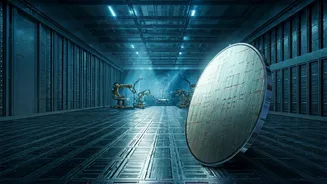
The Tera-fab facility is expected to specialize in producing cutting-edge 2-nanometer chips, a testament to the advanced technological focus of the project. Projections indicate that the facility will support an output of 100 to 200 gigawatts of computing power annually for terrestrial applications, with an astonishing terawatt of power designated for space-based operations. The chips manufactured will serve two primary functions: first, those optimized for 'edge and inference' tasks, which will be crucial for powering Tesla's robotaxis and Optimus humanoid robots, enhancing their on-board decision-making capabilities. Second, the facility will produce high-power chips specifically engineered for deployment in orbital data centers, a key component of SpaceX's and xAI's future infrastructure. xAI, now a wholly-owned subsidiary of SpaceX, is anticipated to be the largest consumer of these advanced chips.
Orbital Data Centers
Elon Musk's ambitious vision extends to establishing a network of orbital data centers, with the initial phase involving a compact AI data center satellite capable of delivering 100 kilowatts of computing power. This 'mini' data center is envisioned as a foundational element for a much larger constellation, with individual units potentially scaling to megawatt capacities. Beyond Earth's orbit, Musk's long-term aspirations even include launching satellites from the lunar surface as part of a grander vision for widespread abundance. In pursuit of this, Musk has formally approached the U.S. Federal Communications Commission (FCC) to secure authorization for launching one million data center satellites into orbit around Earth, a proposal that has already encountered opposition from Amazon's satellite division.