
The Catastrophic Collision
The incident unfolded around 7:45 pm on a Sunday near Adamuz, a village in Córdoba province. A high-speed train, en route from Malaga to Madrid, experienced
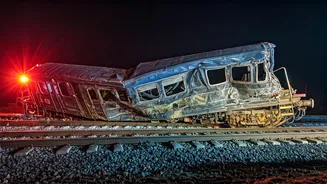
a derailment. Its rear section veered onto the opposite track and collided head-on with an incoming train traveling from Madrid to Huelva. The impact was described by a survivor as akin to an earthquake, capturing the sheer force and suddenness of the event. According to reports, the collision involved the rear portion of one train smashing into the front of another, leading to two carriages derailing and tumbling down a four-meter slope. Rescue operations, involving Spain’s Civil Guard, Civil Protection units, and military emergency teams, worked tirelessly through the night in challenging conditions to reach the crash site.
Immediate Aftermath & Rescue
In the immediate aftermath, emergency services faced the daunting task of navigating a difficult-to-access crash site. Teams worked persistently through the night, battling the cold to assist survivors. Spain's Transport Minister Óscar Puente confirmed that all survivors were rescued by midnight. He also provided the updated death toll, which stood at 21, while acknowledging the possibility of further confirmations. The scale of the tragedy was underscored by the Prime Minister Pedro Sánchez's description of it as “a night of deep sadness” for Spain. King Felipe VI, Queen Letizia, and European Commission President Ursula von der Leyen also extended their condolences, reflecting the widespread sorrow and international concern surrounding the incident.
Survivor's Account
Salvador Jiménez, a journalist with Spanish broadcaster RTVE, was a passenger on one of the trains and recounted the harrowing moments of the crash. He described the terrifying sensation of the derailment and collision as feeling like an earthquake, a vivid testament to the violent forces at play. His account offers a glimpse into the trauma experienced by those caught in the disaster. The journalist's perspective highlights the chaos and the profound shock felt by those present during the event, emphasizing the suddenness and intensity of the collision that resulted in a tragic loss of life and serious injuries. His testimony provides a direct, emotional understanding of the devastating event.
Official Response and Inquiry
Following the tragedy, an official inquiry was launched to determine the cause of the crash. Transport Minister Óscar Puente indicated that the investigation could take up to a month to complete. The investigation's purpose is to methodically examine all factors that contributed to the incident, aiming to establish accountability and prevent future occurrences. The inquiry’s meticulous approach is vital in understanding the technical and operational aspects that led to the collision. It also seeks to determine if there were any failures in safety protocols or underlying causes that may have contributed to the derailment. The investigation's findings will be crucial for improving rail safety standards and providing clarity to the public regarding the causes of this devastating event.