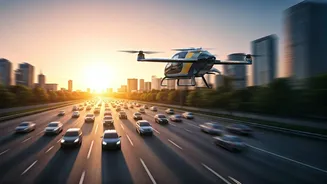








Future of Commuting
A significant leap towards revolutionizing urban transportation was marked by the recent successful demonstration flight of an all-electric vertical takeoff
and landing (eVTOL) aircraft. This pioneering flight connected Manhattan directly to John F. Kennedy International Airport, offering a stark contrast to the typical two-hour journey mired in traffic. Operated by an electric air taxi firm, the vehicle showcased its capability to navigate the skies efficiently. This advanced aircraft, resembling a large, battery-powered drone, is designed to accommodate five individuals, including the pilot. It utilizes a unique propulsion system where it takes off vertically like a helicopter, then strategically tilts its propellers to achieve forward motion. Proponents highlight its quieter operation and zero emissions compared to traditional helicopters, aligning with growing environmental concerns and the push for sustainable transit solutions in densely populated areas. Such initiatives are crucial for redefining city mobility and reducing the environmental impact of daily commutes.
Regulatory Milestones
The development of these innovative air taxis is closely intertwined with evolving regulatory frameworks, particularly from the Federal Aviation Administration (FAA). The FAA employs a structured, five-stage process for certifying new aviation technologies, ensuring safety and operational readiness. Recent advancements have seen the FAA publish new guidelines specifically addressing the integration of air taxis into the existing aviation landscape. This meticulous certification path is essential for building public trust and enabling the widespread adoption of this futuristic transport. Alongside these regulatory efforts, the US Department of Transportation has identified and selected eight pilot programs across the country dedicated to testing eVTOLs. These trials encompass a broad spectrum of applications beyond just passenger transport, including regional travel, cargo delivery, emergency services, autonomous flight, and supporting the offshore energy sector. The data gathered from these real-world simulations is instrumental for the FAA in formulating comprehensive regulations that will safely scale this transformative technology.
Advancing Air Mobility
The groundbreaking demonstration flights, spearheaded by companies like Joby Aviation, represent a critical phase in advancing the field of urban air mobility. By conducting these tests within a major metropolitan area like New York City, with its notoriously challenging traffic patterns, the potential benefits of air taxi services are vividly illustrated. These flights are not merely about speed; they are about demonstrating the viability and safety of a completely new mode of transport. Officials from the Port Authority of New York and New Jersey have expressed enthusiasm for exploring how next-generation aviation can better serve the region's inhabitants. The ongoing testing and the proximity to FAA certification underscore a commitment to moving this technology from concept to reality. As the industry progresses, the focus remains on integrating these eVTOLs seamlessly and safely into the existing infrastructure, offering a tangible solution to the perennial problem of ground-level congestion and significantly reducing travel times for millions.