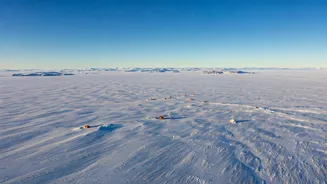

Trump's Greenland Fascination
Donald Trump's expressed interest in acquiring Greenland, an autonomous territory of Denmark, created quite a stir in the international community. The
idea, which reportedly emerged during private discussions, was met with surprise and amusement in many circles. Some interpreted it as a display of the former president's unconventional approach to foreign policy, while others saw it as a reflection of his focus on strategic acquisitions. The proposal was ultimately dismissed by Danish officials, who emphasized Greenland's autonomy and the historical ties between Greenland and Denmark. Nevertheless, the incident generated discussions regarding the strategic importance of Greenland and the Arctic region as a whole. Trump's interest highlighted the increasing significance of the Arctic, as climate change opens up new shipping routes and makes the area more accessible for resource extraction. This has intensified geopolitical competition among major players, including the United States, Russia, and China.
Strategic Arctic Significance
Greenland's strategic location in the Arctic makes it a key player in global geopolitics. The island sits between the North American and European continents, offering significant control over key shipping routes. The melting of Arctic ice due to climate change is making the region more accessible, opening up new opportunities for shipping, resource extraction, and military activities. As a result, Greenland has become a focal point of interest for various nations, including the United States. Its proximity to both North America and Europe, coupled with its vast natural resources, makes it valuable from a strategic perspective. The potential for future resource exploitation, along with the development of new shipping lanes, has increased the importance of Greenland, making it an area of heightened geopolitical competition. The country's autonomy allows it to maintain its own interests while navigating these complex international dynamics.
International Reactions Emerge
The international response to Trump's Greenland proposal was largely one of surprise and skepticism. European leaders and other global powers saw it as an unorthodox and unrealistic proposition. Denmark's Prime Minister quickly dismissed the idea, asserting Greenland's autonomous status and Denmark's historical connection to the territory. The response highlighted the importance of international norms and diplomatic protocols in managing sovereign territories. Some commentators also pointed to the potential destabilizing effects of such an action on global relationships. The episode sparked conversations regarding the limits of unilateral actions in international relations and reaffirmed the significance of respecting national sovereignty. It underscored the importance of diplomacy and collaboration in dealing with significant geopolitical issues. Overall, the reaction highlighted the significance of diplomatic norms in international relations and underscored the importance of respecting national sovereignty.
Why Greenland Matters
Greenland's significance stems from its strategic location, resource potential, and the impact of climate change. Its position in the Arctic, along the shortest route between the North American and European continents, gives it substantial importance. The melting of Arctic ice due to climate change is opening up new shipping routes, making the area more accessible for resource extraction. Greenland is believed to have extensive mineral resources, including rare earth elements, which are vital for modern technology. However, exploiting these resources presents significant environmental challenges and requires careful consideration of sustainability. Moreover, Greenland's geopolitical significance is amplified by its location within the Arctic Circle. The area is becoming increasingly important due to climate change. All these factors contribute to Greenland’s global importance, making it a focal point of international interest and debate.
Geopolitical Implications Unfold
The focus on Greenland has far-reaching geopolitical implications. It underscores the rising importance of the Arctic in international relations. The former president's interest in Greenland brought the strategic importance of the area to the forefront. As the Arctic ice melts, new shipping routes become accessible, and mineral resources open up, the region is becoming a source of contention between global powers. This increases the potential for both collaboration and conflict. The situation also raises questions about national sovereignty, international law, and the appropriate conduct in foreign policy. The incident emphasized the need for careful diplomacy and collaboration among nations, especially as they navigate an evolving geopolitical landscape. Ultimately, Trump's interest in Greenland serves as a microcosm of broader shifts in global power and resource competition, impacting international relations.