





A Satellite's Farewell
NASA's Van Allen Probe A, a significant tool in understanding Earth's radiation belts, concluded its mission after approximately 14 years. This defunct
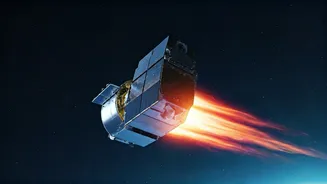
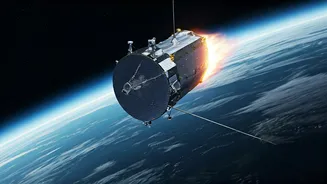
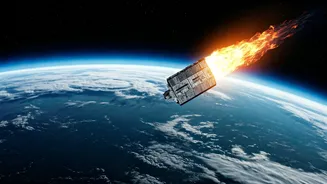
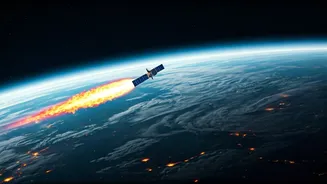
satellite, weighing around 1,323 pounds, embarked on its final journey back to our planet. The United States Space Force provided an estimated re-entry time, pinpointing Tuesday around 7:45 p.m. EDT. Crucially, this re-entry is classified as 'uncontrolled.' This means that unlike meticulously planned descents, NASA has no capability to steer the satellite's trajectory. The vast majority of the spacecraft is anticipated to disintegrate and vaporize as it encounters the intense friction and heat of Earth's atmosphere during its rapid plunge. Despite the dramatic nature of its return, NASA has reassured the public that the probability of any component causing harm to individuals on Earth is remarkably low, estimated at approximately 1 in 4,200. Continuous monitoring by NASA and the Space Force is in place to refine these re-entry predictions as the event approaches.
The Sky's Debris Field
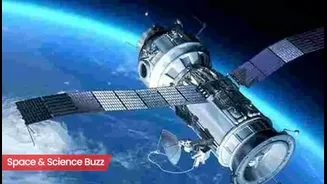
Our skies are teeming with thousands of satellites, vital for services we rely on daily, from global communication and internet access to precise navigation. With over 5,000 satellites already in orbit, this number is set to skyrocket, especially with ambitious projects like SpaceX's Starlink program. Consequently, the return of defunct objects to Earth is a common occurrence. Annually, Earth's atmosphere diligently processes more than 100 tonnes of space debris, typically rendering it harmless by burning it up long before it reaches the ground. These events usually pass without notice due to their innocuous nature. However, a substantial increase in falling satellites could have significant repercussions. The sudden loss of functioning satellites would immediately disrupt essential services. Imagine widespread outages in communication networks, intermittent internet connectivity, and unreliable GPS systems, impacting everything from daily navigation to aviation and global commerce. The descent of these objects wouldn't be a single, massive event; their orbital paths and altitudes mean some could take years, or even decades, to fall.
Navigating the Fall
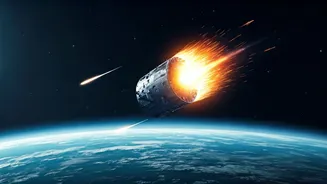
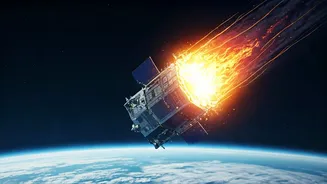
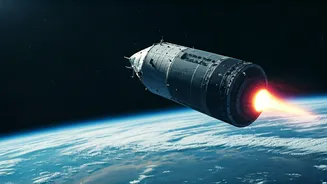
When satellites do return, the primary mechanism of their destruction is the Earth's atmosphere. The immense speeds at which they descend create friction, generating extreme heat that causes most of the material to vaporize. However, for very large or dense components, complete disintegration isn't always guaranteed, and fragments can survive the fiery passage. Typically, space agencies make concerted efforts to control a satellite's final moments, guiding its descent towards sparsely populated areas, often remote ocean regions. This controlled re-entry minimizes the risk of any debris impacting inhabited landmasses. Yet, in a scenario with numerous uncontrolled descents, the risk of fragments landing anywhere on the planet increases. While oceans cover the majority of Earth's surface, the sheer speed of surviving fragments means they could still pose a threat if they land on land. Despite these concerns, the protective blanket of our atmosphere is highly effective, ensuring that the vast majority of incoming space objects are safely neutralized before reaching the ground. Predicting the exact timing and location of an uncontrolled re-entry is a complex challenge, influenced by atmospheric conditions, solar activity, and orbital dynamics, often resulting in a window of uncertainty, as seen with Van Allen Probe A's predicted descent.
Van Allen Mission Legacy
The Van Allen Probe A, along with its identical twin, Van Allen Probe B, was launched by NASA on August 30, 2012. Their primary objective was to conduct in-depth research into the Van Allen radiation belts, which are donut-shaped regions encircling our planet, trapping high-energy particles. These belts play a crucial role in shielding Earth from the harmful effects of solar storms, cosmic radiation, and streams of charged particles known as the solar wind. Understanding these belts is vital not only for protecting life on Earth but also for ensuring the safety of astronauts traveling beyond our atmosphere. Throughout their mission, these twin probes provided invaluable data, enhancing our comprehension of the radiation belts. They even made a significant discovery, identifying a transient third radiation belt that can manifest during periods of intense solar activity. The probes continued their scientific work until 2019, when they ran out of fuel, marking the conclusion of their operational lifespan. Scientists had initially projected that both probes would return to Earth's atmosphere around 2034. However, increased solar activity in recent years has led to a greater atmospheric drag, gradually pulling their orbits lower. This phenomenon is the reason why Van Allen Probe A is re-entering earlier than anticipated, while Van Allen Probe B is expected to remain in orbit until at least 2030.