
Why Rafale?
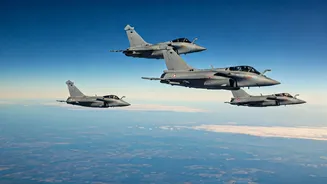
India's decision to purchase the French Rafale over its American and Russian competitors was a pivotal moment in the nation's defense strategy. The choice
was not merely about acquiring advanced weaponry, but also about building strategic relationships and ensuring technological independence. The Rafale, manufactured by Dassault Aviation, presented a versatile and multirole combat aircraft suitable for India's diverse operational needs. Its capabilities included air-to-air combat, ground attack, and reconnaissance, providing a comprehensive solution. Moreover, the Rafale's integration with existing Indian military infrastructure and its established track record were crucial factors. The negotiation process also played a vital role, with France offering favorable terms that addressed India's requirements for technology transfer and indigenous production, promoting self-reliance in defense manufacturing. This approach aligned perfectly with India's broader vision of 'Atmanirbhar Bharat' (Self-reliant India), emphasizing local production and reducing dependence on foreign suppliers. Furthermore, France's willingness to provide comprehensive support, including training and maintenance, added to the Rafale's appeal. Thus, the choice of the Rafale was a calculated move that reflected India's evolving geopolitical strategies and its dedication to modernizing its defense capabilities.
US vs. Rafale
The United States, with its long-standing strategic partnership with India, offered its cutting-edge F-35 fighter jets. However, several factors made the Rafale a more suitable choice for India. The F-35, while possessing stealth capabilities and advanced technology, came with certain limitations. Its operational and maintenance costs were significantly higher, and the stringent export controls associated with the F-35 could have restricted India's operational flexibility. Furthermore, India was keen on technology transfer to boost its indigenous manufacturing capabilities. The terms offered by the US regarding technology transfer were less favorable compared to those of France. The Rafale, though not a stealth aircraft like the F-35, offered a robust multirole platform that fulfilled India's immediate operational needs. It had a proven track record in various international conflicts and offered a good balance of capabilities and cost-effectiveness. In addition, the Rafale could be integrated with India's existing air force infrastructure more easily. The decision reflected a strategic prioritization of immediate operational requirements, cost-effectiveness, and the opportunity for technology transfer over the cutting-edge but complex capabilities offered by the F-35.
Russia and the Su-57
Russia's Su-57, another contender, represented an advanced fighter jet option. However, several considerations influenced India's decision. The Su-57, while offering a potent combination of speed and maneuverability, had complexities regarding its development and operational readiness. The aircraft was still under development during the procurement process. The partnership with Russia on the Su-57 would have entailed significant investment in joint development and production, which carried certain risks. The timelines and uncertainties associated with such a collaborative project were less appealing than the immediate availability and established capabilities of the Rafale. Furthermore, India was keen to diversify its defense partnerships to reduce over-reliance on any single supplier. While Russia remained a crucial partner for India in defense, the Rafale offered an opportunity to diversify its arsenal. The Rafale’s proven performance and availability, coupled with favorable terms from France, made it a more attractive option compared to the developmental uncertainties of the Su-57. Ultimately, this choice balanced strategic considerations with practical operational needs and risk management.
Strategic Implications
The selection of the Rafale over the US and Russian alternatives carried significant strategic implications for India. This decision underscored India's commitment to building a diverse and balanced defense portfolio, reducing dependency on any single nation. By choosing the Rafale, India strengthened its relationship with France, reinforcing a long-standing partnership. This choice also opened avenues for further collaboration in defense technology and joint ventures. Furthermore, the decision showed India's growing confidence in its ability to navigate complex geopolitical landscapes, making strategic choices that serve its national interests. The emphasis on technology transfer and indigenous production aligned with India's vision of self-reliance, enhancing its defense manufacturing capabilities and reducing reliance on imports. This strategic move enabled India to maintain its operational readiness while pursuing technological advancements and strengthening international partnerships, reflecting its role as a key player in the global arena.