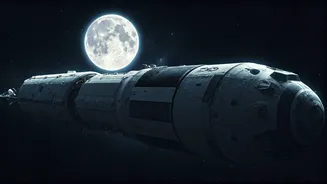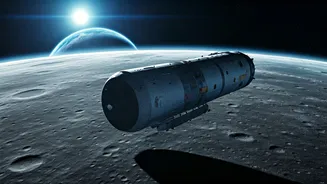



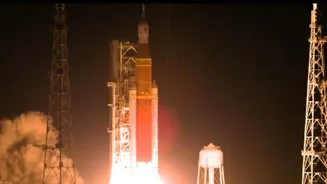
Towering Titan of Space
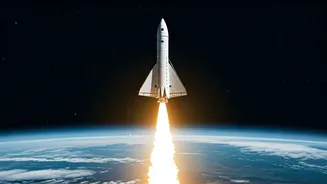
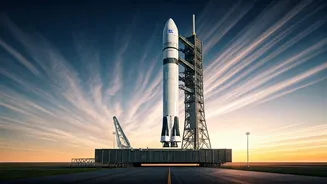
NASA's Artemis II mission is gearing up for a significant lunar flyby, powered by the monumental Space Launch System (SLS) rocket. In its 'Block 1' configuration,
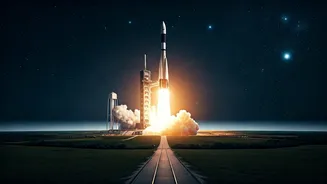
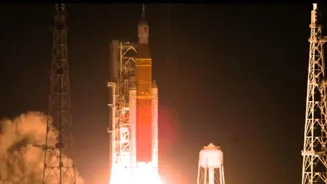
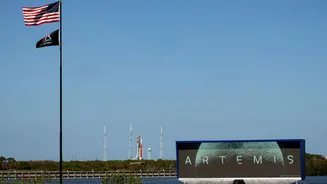
this launch vehicle stands an impressive 322 feet (98 meters) tall, a height that surpasses even the iconic Statue of Liberty, which measures 305 feet. Scheduled for launch on April 1, 2026, from Launch Complex 39B at the Kennedy Space Center, the SLS is engineered as a super-heavy-lift vehicle, designed to enable humanity's return to deep space for the first time since the Apollo era in 1972. While it falls short of the Apollo-era Saturn V's 363-foot stature, the SLS compensates with sheer power. It generates a staggering 8.8 million pounds of maximum thrust, approximately 15% more than its predecessor, earning it the title of the most powerful operational rocket ever constructed. When fully loaded with propellant on the launchpad, the entire rocket assembly tips the scales at an astonishing 5.75 million pounds, ready to carry the Orion spacecraft and its four-person crew on their ambitious journey.
Anatomy of Power
The Space Launch System (SLS) is meticulously constructed with several critical components, each playing a vital role in its ascent into space. The centerpiece is the Core Stage, an imposing 212-foot-tall structure, painted in its signature orange hue. This massive section houses four RS-25 engines, which were previously used in the Space Shuttle program, and holds an immense 733,000 gallons of liquid hydrogen and liquid oxygen fuel. Flanking the Core Stage are two towering Solid Rocket Boosters (SRBs), each measuring 177 feet in length. These powerful boosters are responsible for generating over 75% of the rocket's total thrust during the crucial initial two minutes of flight. Completing the propulsion system is the Upper Stage, known as the Interim Cryogenic Propulsion Stage (ICPS). This component provides the final, essential impulse required to propel the Orion spacecraft out of Earth's orbit and en route to its lunar destination. Together, these elements form a potent combination designed for the rigors of deep-space exploration.
Journey to the Moon
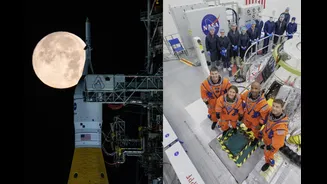
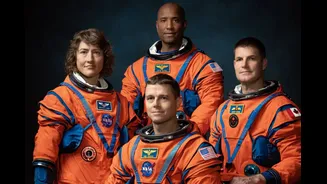
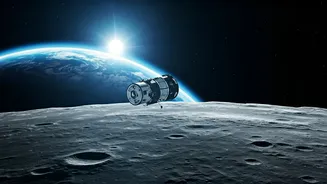
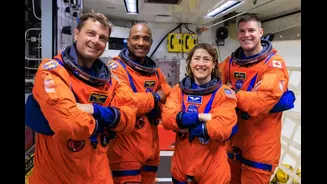
The Artemis II mission itself is a pivotal step, serving as the final flight test before astronauts make their return to the lunar surface. This historic voyage will be crewed by Commander Reid Wiseman, Pilot Victor Glover, and Mission Specialists Christina Koch and Jeremy Hansen. Over a 10-day period, the mission will take the crew on a lunar flyby, utilizing a 'free-return' trajectory. This clever path leverages the Moon's gravitational pull to naturally slingshot the spacecraft back toward Earth, negating the need for extensive propulsion maneuvers for the return trip. The mission is anticipated to push the boundaries of human exploration, traveling an estimated 4,700 miles (7,600 km) beyond the far side of the Moon, a distance greater than any human has previously ventured from our planet. The return journey will be equally challenging, with Orion re-entering Earth's atmosphere at a blistering 25,000 mph. This high-speed descent will rigorously test the spacecraft's heat shield, enduring temperatures that can reach up to 3,000°F, before a safe splashdown in the Pacific Ocean.