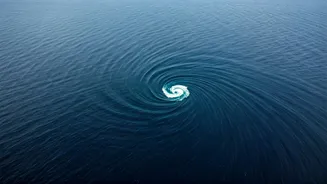

An Oceanic Mystery
The Indian Ocean Geoid Low (IOGL) represents an area where gravity is measurably weaker than the global average. This is not simply a dip in the ocean
floor; it indicates a significant gravitational deficit, a region where the pull of gravity is less intense. The IOGL holds the title of the world's largest and deepest gravity hole, adding to its allure and significance. This makes it an area of intense scientific interest, as researchers attempt to understand its origins and the geological processes that shaped it. The IOGL's presence raises critical questions about the dynamics of the Earth's mantle and the forces that shape the planet's surface. Scientists employ various techniques, including satellite-based measurements of the Earth's gravitational field, to study this unique region. These observations enable them to map the subtle variations in gravity and gain a better understanding of the subsurface structures causing the anomaly.
Size and Scale
The sheer scale of the Indian Ocean Geoid Low is staggering. This gravity anomaly spans a vast area within the Indian Ocean, making it the largest in the world. Its considerable size highlights the significant difference in gravity. The depth of the IOGL is also noteworthy, with the gravity deficit reaching remarkable levels. The extreme magnitude of the gravity deficit demonstrates the immense scale of the geological processes creating it. Comparing the area of the IOGL to other geological features helps highlight its immense scale. Its sheer size makes it an essential subject for global geophysical studies. The extensive scale also presents logistical and technical challenges to scientists studying the area. They need to analyze vast datasets and deploy sophisticated technology to collect and interpret their findings. The massive scale also implies that the underlying geological mechanisms are equally large and complex.
Unveiling the Causes
The precise cause of the Indian Ocean Geoid Low continues to elude scientists, though several theories have emerged. One prominent hypothesis suggests it's linked to the structure of the Earth's mantle, particularly the presence of dense material. This dense material could be the remnants of subducted oceanic plates, creating a density imbalance that results in a weaker gravitational pull. Another theory suggests that it's connected to large-scale mantle flow patterns, where cooler, denser material is sinking, creating the geoid low. The investigation of these theories involves complex simulations and high-resolution data analysis. The challenges in studying this area include the depth of the ocean, the lack of direct access to the mantle, and the immense scale of the feature. There is a need for ongoing research and advanced modeling techniques to refine and test these hypotheses.
Scientific Importance
The study of the Indian Ocean Geoid Low has significant implications for understanding the Earth's internal processes and the evolution of our planet. This research provides vital clues about the dynamics of the Earth's mantle, including the patterns of convection and the movement of tectonic plates. Through the study of the IOGL, scientists can refine models of the Earth's structure and behavior. The research offers a unique window into understanding the deep Earth and the forces that shape the planet’s surface. Understanding the origins of the gravity anomaly allows scientists to better comprehend the history of the Indian Ocean and the processes that have shaped the continents surrounding it. This work also provides a deeper understanding of the dynamics of the Earth's interior and its influence on surface features.
Future Research
Ongoing research into the Indian Ocean Geoid Low employs diverse strategies and technologies. Scientists use advanced satellite missions to precisely measure variations in the Earth's gravitational field. They are developing improved geological models and analyzing seismic data to create a 3D picture of the mantle. They are studying the interaction between the mantle and the overlying oceanic crust. Collaborations across various disciplines are critical for enhancing our understanding. Future research may include the deployment of autonomous underwater vehicles and improved drilling techniques to get direct samples from the mantle. This collaborative, multi-faceted approach holds the promise of unlocking more secrets about the IOGL and its significance in understanding our planet's deep Earth processes.