

Mapping the Deep Unknown
For too long, the ocean's floor has remained a greater mystery than the surface of the Moon, with vast swathes of it uncharted. However, this deficit in knowledge
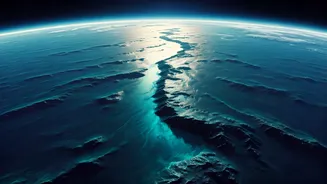
is rapidly diminishing thanks to a groundbreaking initiative by NASA. The space agency has introduced a novel approach to charting the seabed, utilizing data gathered from its orbiting satellites. This ambitious project forms an integral part of a global endeavor aiming to produce a comprehensive and highly detailed map of the entire ocean floor by the close of this decade. The implications of this are profound, promising to reshape our understanding of marine environments and Earth's underlying structure.
Satellites See Beneath Waves
The cutting-edge map originates from the Surface Water and Ocean Topography (SWOT) satellite, a collaborative mission between NASA and the French space agency CNES. Since its launch in December 2022, SWOT has been diligently surveying our planet, capable of scanning approximately 90% of Earth's surface every three weeks. Rather than directly capturing images of the submerged terrain, SWOT employs an ingenious indirect method. It meticulously measures minute variations in water levels across oceans, lakes, and rivers. These subtle undulations on the water's surface are precisely what provide clues to the topography hidden far below.
Gravity's Underwater Clues
The science behind this orbital mapping hinges on the principle of gravity. Substantial underwater geological formations, such as massive seamounts or extensive ridges, possess greater mass. This increased mass exerts a slightly stronger gravitational pull on the overlying water. Consequently, these gravitational anomalies manifest as minuscule bulges or dips in the ocean's surface. By analyzing these minute shifts in water height, scientists can effectively infer and reconstruct the shape and contours of the seafloor. It's a sophisticated method of seeing the unseen through the subtle influence of mass on a planetary scale.
Enhanced Detail Revealed
David Sandwell, a geophysicist at the Scripps Institution of Oceanography, highlights that the SWOT satellite represents a significant leap forward in our capacity to map the ocean floor. Previous satellite technologies were limited, capable of detecting only exceptionally large features, such as seamounts exceeding one kilometer in height. In contrast, SWOT possesses a much greater sensitivity. This allows it to identify underwater features that are less than half that size, thereby presenting a considerably more detailed depiction of the ocean floor. Researchers anticipate this enhanced detail could drastically increase the number of known seamounts, potentially raising the count from around 44,000 to as many as 100,000.
Importance of Seabed Mapping
Understanding the configuration of the ocean floor is crucial for a multitude of reasons. It plays a vital role in refining navigational charts and optimizing shipping lanes, ensuring safer and more efficient maritime transport. Furthermore, detailed seabed maps are indispensable for the strategic planning and laying of crucial underwater communication cables that connect our global society. Identifying potential undersea hazards, such as submerged obstacles or unstable slopes, is another critical application. Beyond these practical uses, seafloor mapping is fundamental to studying complex oceanographic phenomena like currents and tides, as well as understanding delicate marine ecosystems. It also provides invaluable insights into plate tectonics and the ongoing processes that shape Earth's dynamic surface over geological timescales.
Towards a Global Map
The data analysis from SWOT is a key component of a broader international initiative targeting a complete mapping of the global seafloor by 2030. While traditional ship-based sonar surveys remain essential for obtaining the highest resolution measurements, satellites like SWOT offer an unparalleled ability to cover immense geographical areas rapidly. Sandwell suggests that while the full scope of ship-based mapping might not be completed by the 2030 deadline, SWOT's contribution will be instrumental in filling the gaps, bringing the world significantly closer to achieving this ambitious objective. As more data is continuously gathered and meticulously analyzed, scientists anticipate further refinements to these emerging maps, marking a pivotal advancement in exploring one of Earth's most enigmatic frontiers.