






Economic Warfare Unleashed
The landscape of aerial combat is undergoing a seismic shift, driven by the proliferation of low-cost drones. Instead of relying on a few extremely expensive,
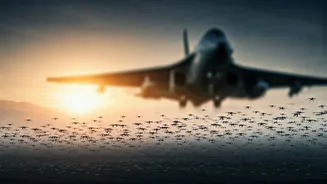
high-tech aircraft, nations are now embracing a strategy of "precise mass" – deploying large numbers of inexpensive, expendable unmanned aerial vehicles. This approach defines the current "war of exhaustion," where attackers leverage drones costing around $20,000 to compel defenders to expend interceptor missiles valued at up to $3 million per unit. This stark cost disparity creates a significant economic imbalance, compelling adversaries to drain their finite resources by intercepting swarms of drones that represent a fraction of the interceptor's cost. Reports indicate that in recent campaigns, defensive expenditures to counter drone swarms have exceeded $1.4 billion, while the attackers' drone costs were a mere $360 million, highlighting the profound financial leverage of this new tactic.
Diverse Drones in Action
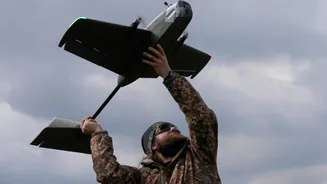
A variety of affordable drones are currently playing crucial roles in ongoing conflicts. The Shahed-136, priced between $20,000 and $50,000, is a long-range "suicide" drone capable of swarming attacks on fixed targets, utilized by Iran, Russia, and Houthi rebels. In contrast, highly agile FPV quadcopters, costing between $500 and $1,000 and often built with Chinese components, are being repurposed by Ukraine and Russia as precise kamikaze weapons for engaging moving vehicles or entrenched positions. Russia also employs the ZALA Lancet ($20,000–$40,000), a loitering munition designed for precision strikes on high-value armor and artillery. The United States is fielding the LUCAS/FLM-136 ($35,000), a budget-friendly replica of the Shahed-136 aimed at overwhelming air defenses through sheer numbers. Ukraine utilizes the Hornet Queen ($2,000–$5,000), a larger FPV platform serving as a bomber or drone carrier. Russia's Gerbera ($10,000) acts as a decoy, mimicking the Shahed to exhaust enemy missile stocks. Ukraine has developed the 'Sting' Interceptor ($2,500), a high-speed FPV drone specifically for mid-air drone takedowns. The Switchblade 300 ($6,000), used by Ukraine and the US, is a portable "flying shotgun" for precise anti-personnel missions. Finally, fiber-optic FPV drones ($800–$2,000), employed by both Russia and Ukraine, offer immunity to electronic jamming due to their wired control.
New Counter-Drone Strategies
In response to the drone threat, militaries are actively developing cost-effective countermeasures. The concept of "drone-on-drone" combat is gaining traction, with Ukraine leading the way by deploying small, swift interceptor drones that cost between $1,000 and $4,000. These drones are designed to physically collide with or detonate near incoming enemy UAVs. The U.S. has also introduced its AI-driven Merops drone for similar purposes. Traditional methods are also being revived and adapted; mobile machine-gun units and repurposed propeller aircraft equipped with gunmen are being utilized to shoot down drones at minimal expense. Cutting-edge solutions are also in development, including laser systems and high-power microwave emitters that can neutralize drones at the speed of light, with operational costs limited to electricity consumption.
The 'Copycat' Era
The pace of defense innovation has accelerated dramatically, bypassing traditional, decade-long procurement cycles. The U.S. military, for instance, developed the FLM-136 LUCAS, a $35,000 one-way attack drone, in just 18 months by reverse-engineering the Iranian Shahed design to address its own need for affordable precision strike capabilities. Ukraine has achieved an impressive production scale, manufacturing over 4 million drones annually. This rapid output fosters an environment akin to "Silicon Valley," characterized by swift iteration and development rather than slow, bureaucratic processes. Drones are evolving from specialized assets for elite units to integral components of every infantry squad, effectively serving as "expendable ammunition."
Technological Advancements
By 2026, modern drones are increasingly equipped to overcome their primary vulnerability: electronic warfare. To combat jamming, new drone designs incorporate AI-driven machine vision, such as the TFL-1 module, enabling them to lock onto targets in the critical "last mile" of their flight, ensuring mission completion even if the radio link is disrupted. Some front-line FPV drones are now tethered with physical fiber-optic cables, rendering them completely impervious to radio frequency interference. Furthermore, operators are shifting from controlling individual drones to managing coordinated swarms of 10 to 20 units that can autonomously plan and execute complex movements.