



Ancient Indian Origins
The genesis of resist-dyeing techniques, a precursor to what we now recognize as Batik, can be traced back over two millennia in India. Evidence suggests
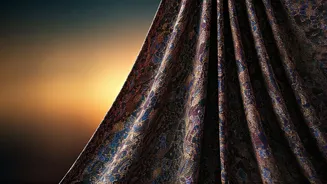
that rudimentary resist-printing on cotton fabrics was a practiced art form as early as the 1st century AD. While no direct cotton artifacts from this period have survived due to the challenging tropical climate, historical depictions in the Ajanta and Ellora cave frescoes offer compelling visual proof. These ancient murals showcase figures adorned in garments featuring distinct, often geometric, patterns characterized by the subtle crackling that is a hallmark of Batik. India's significant advantage in early textile production stemmed from its superior quality cotton and a rich palette of natural dyes, particularly the deep indigos and vibrant alizarine reds derived from madder roots, which provided the foundational elements for these early textile traditions.
Javanese Refinement
The narrative of Batik took a significant turn with the expansion of maritime trade routes, facilitated by Indian merchants venturing across Southeast Asia. During these extensive voyages, Indian traders encountered the sophisticated textile practices of the Javanese. While Indian artisans were primarily employing coarser mud or sand resists, a local method known as Dabu, the Javanese had perfected a far more precise technique. They utilized molten wax, applied with a specialized tool called a Tjanting, to create intricate designs. Recognizing the immense potential of this wax-resist method, Indian merchants enthusiastically adopted it, introducing it to their own burgeoning textile industries, particularly within the Khatri merchant communities along the Gujarat trade routes. This cross-cultural exchange marked a pivotal moment in the evolution of Batik.
Indian Adaptation and Innovation
Upon its arrival in India, the refined wax-resist technique from Java was not merely adopted but ingeniously reinterpreted and localized. While Javanese Batik often bore ceremonial significance, featuring royal emblems and cosmic symmetry, Indian artisans infused the craft with regional character and artistic flair. Ujjain, in Madhya Pradesh, transformed into a major production center, with local craftsmen abandoning their traditional Dabu methods for the smoother wax application. This shift led to the creation of strikingly unique textiles adorned with local tribal motifs and depictions of flora and fauna. Further west, artisans in Kutch, Gujarat, masterfully combined the fluid wax process with their penchant for incredibly sharp and intricate geometric patterns. Meanwhile, in Andhra Pradesh and Telangana, artists explored a different dimension, using wax to illustrate elaborate mythological narratives and vibrant scenes of rural life, showcasing the diverse artistic interpretations of Batik across India.
Modern Revival and Global Reach
The advent of the Industrial Revolution posed a significant threat to traditional crafts like Batik, with mass-produced fabrics and synthetic dyes nearly causing its demise. However, the 20th century witnessed a remarkable resurgence. Rabindranath Tagore played a pivotal role in this revival, integrating Batik as a formal discipline at the art school within his Visva-Bharati University in Shantiniketan, West Bengal. This initiative elevated Batik from a struggling handicraft to a respected fine art, even leading to the invention of leather Batik, which became synonymous with beautifully hand-painted leather goods. In the 1960s, the Madras School of Arts further propelled Batik into the international spotlight, with 'Madras Batik' becoming a symbol of the Western counterculture movement. Today, the distinctive crackled patterns of Batik continue to captivate, representing a rich legacy of maritime trade, cultural fusion, and enduring artistic expression that spans continents.