






Mantis Shrimp's Super Sight
The mantis shrimp boasts arguably the most sophisticated visual system known in the animal kingdom. Its eyes possess an incredible 12 to 16 distinct types
of photoreceptors, far surpassing the human count of three. This remarkable biological hardware allows them to perceive ultraviolet light, polarized light, and an exceptionally wide spectrum of colours that remain invisible to us. Furthermore, each of their independently moving eyes can also ascertain depth, granting them a profound understanding of their surroundings. This advanced vision is crucial for their survival, aiding in both hunting prey and navigating their complex marine environment with unparalleled precision and detail.
Tarsier's Enormous Orbs
Tarsiers, small nocturnal primates, are immediately striking due to their disproportionately massive eyes, which are nearly the same size as their entire brain. These oversized ocular features are a critical adaptation for life in low-light conditions, as they are designed to capture as much ambient light as possible, compensating for the lack of certain other night-vision enhancements found in different species. However, this remarkable visual acuity comes with a trade-off: their eyes are fixed within their sockets and cannot move. To compensate for this immobility, tarsiers have developed an extraordinary ability to rotate their heads almost 180 degrees, allowing them to survey their environment without shifting their gaze.
Chameleon's Panoramic Vision
Chameleons possess truly unique eyes that can operate independently of each other, providing an almost 360-degree view of their surroundings. This allows them to meticulously scan their environment for potential threats or opportunities while simultaneously maintaining a sharp focus on their immediate prey. Their visual system is also equipped for monocular depth perception and incredibly rapid focusing capabilities. These features are paramount for their success as insectivores, enabling them to accurately judge distances and strike with astonishing speed and precision to capture their meals on the wing.
Dragonfly's 360-Degree View
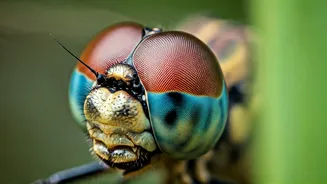
Dragonflies are equipped with enormous compound eyes, each composed of tens of thousands of individual visual units, collectively occupying a significant portion of their heads. This extraordinary ocular architecture grants them nearly complete 360-degree vision, a phenomenal advantage in their aerial pursuits. Their vision is exceptionally adept at detecting rapid movements, making them formidable predators in the sky, even when operating in dim light conditions. This widespread visual field ensures they miss very little, crucial for both hunting agile prey and evading their own predators.
Gecko's Nighttime Acuity
Geckos are renowned for their exceptional night vision, a capability that far exceeds that of humans. Their eyes are significantly more sensitive to light, and specialized cells within their retinas, along with unique lens structures, allow them to perceive colours even in very dim environments. The distinctive vertical slit pupils of geckos play a vital role in controlling the amount of light entering their eyes, further enhancing their ability to see clearly after dark. This sophisticated visual adaptation is essential for their nocturnal lifestyle, enabling them to navigate and hunt effectively when most other creatures are inactive.
Sea Urchin's Body-Wide Vision
In a fascinating departure from the norm, sea urchins lack conventional eyes altogether. Instead, their entire body essentially functions as a visual organ. They possess light-sensitive cells known as photoreceptors distributed throughout their tube feet. This unique arrangement allows them to detect light and movement across a broad area of their body, providing a diffuse sense of their surroundings. This rudimentary yet effective visual system helps them react to environmental changes and potential dangers, even in the absence of dedicated visual organs.
Ostrich's Expansive Gaze
Ostriches possess eyes that are notably larger than their brains, an adaptation that grants them an exceptionally wide field of vision. This expansive visual range is a critical survival tool, particularly in their natural habitat of open plains where early detection of predators is paramount. The long, thick eyelashes adorning their eyes serve a crucial protective function, shielding them from the harsh elements, including dust and debris, that are prevalent in their environment. This combination of broad sight and eye protection ensures their continued safety and ability to thrive.