




The Fan Conundrum
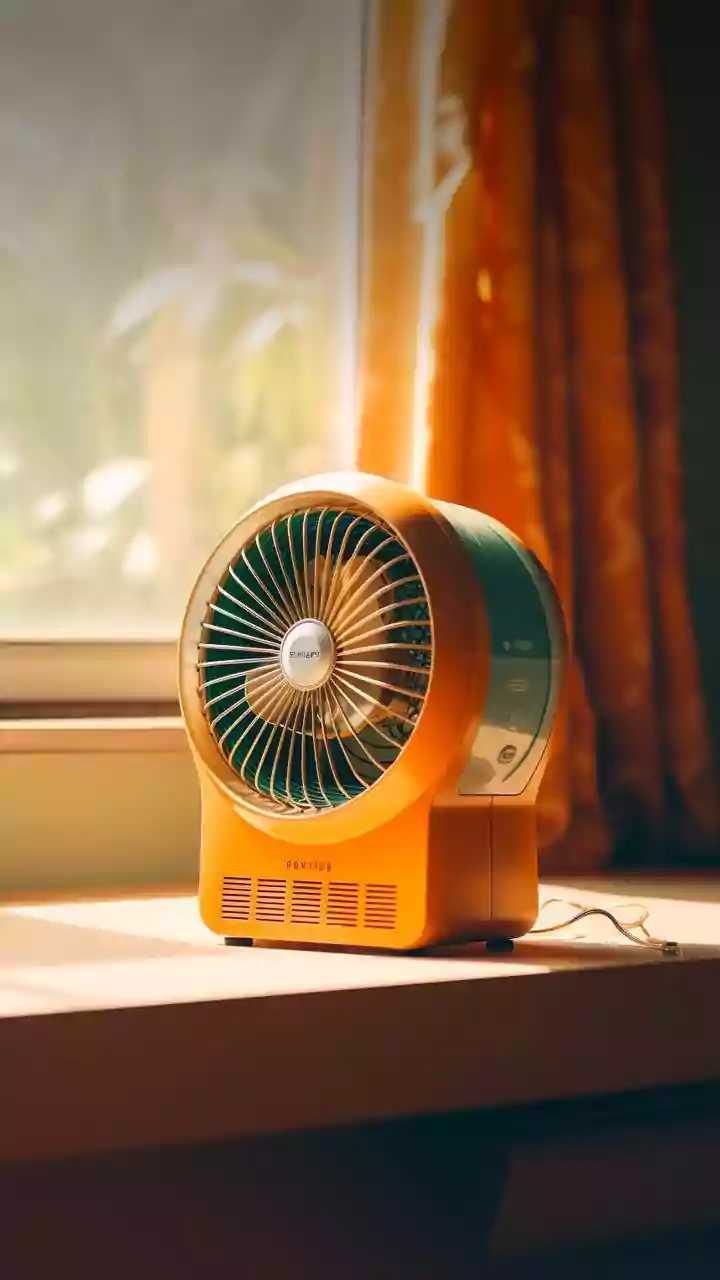
Many people believe that to cool a room with a fan, the best approach is to position it to blow air directly out of a window, thus expelling hot air. However,
research suggests this common practice may not be the most efficient method. While it does remove some warm air, it often fails to create the desirable cooling breeze that makes a significant difference on a hot day. The physics of air movement involve more than just pushing air; it’s about managing pressure differentials and temperature zones within a space. Understanding how to manipulate these invisible air currents is crucial for creating a comfortable environment without relying solely on air conditioning. This involves a nuanced approach to fan placement that leverages principles like negative pressure and the 'cup effect' to circulate air more effectively and promote evaporative cooling.
Negative Pressure & Cup Effect
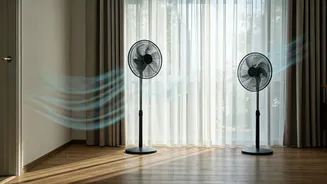
When a fan is directed outwards, it can create a slight vacuum, or negative pressure, within the room. This encourages the room to draw in air from other openings. This strategy can be effective if there's a cooler, shaded area elsewhere in the house providing an alternative air source. However, a more impactful discovery comes from studies using computational fluid dynamics. These analyses reveal that fans facing inward tend to generate a distinctive 'cup-shaped' airflow pattern. This circulating air hugs the contours of the room, promoting better air distribution throughout the entire space. In contrast, a fan blowing outward primarily creates a narrow stream of air towards the window, offering less comprehensive cooling. By facilitating heat transfer and accelerating the evaporation process on your skin, inward-facing fans offer a more noticeable 'wind chill' effect, making warm conditions more bearable.
Humid Conditions & Convection
The effectiveness of typical fan strategies can diminish significantly in environments with high humidity. When the outdoor temperature is higher than indoors, simply replacing stale air with hot, humid outdoor air offers little relief. In such scenarios, the objective shifts to 'convective cooling.' This involves creating high-velocity airflow directly across the skin to enhance the evaporation of sweat, which is the body's natural cooling mechanism. Research indicates that for humid conditions, a fan directed inward, specifically towards occupants, is generally more effective. The focus is on manipulating the 'perceived' temperature through air movement rather than solely attempting to lower the room's actual temperature reading. This approach prioritizes personal comfort by creating a strong breeze that directly aids in cooling the body.
Strategic Fan Timing
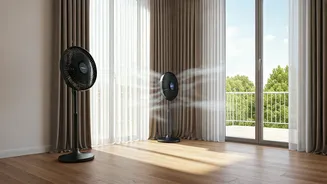
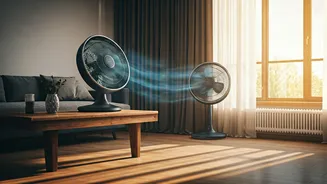
Optimal DIY ventilation requires careful consideration of timing. During the hottest parts of the day, it's beneficial to use a fan to draw cooler air into the house through the most shaded and temperature-advantageous window. As evening approaches and outdoor temperatures drop below indoor levels, the strategy should pivot to cross-ventilation. At this point, one fan can be used to pull cooler evening air into one end of the house, while another fan positioned at the opposite end exhausts the accumulated warm air. This creates a powerful, high-speed airflow tunnel effect, rapidly flushing out the day's heat and significantly reducing the indoor temperature in a short period.
Maximizing Airflow Efficiency
To amplify the effectiveness of your fans, it's essential to pre-plan the desired airflow path. Factors like dust buildup on fan blades or window screens can reduce efficiency, so keeping these clean is important. Furthermore, positioning the fan that draws air in where it's naturally shaded, perhaps by trees or an overhang, helps prevent it from pulling additional heat into the house. Utilize the vertical dimension of your home by leveraging the 'stack effect': place a fan at a higher window to exhaust warmer, rising air, while simultaneously opening a slightly lower window on the opposite side of the house to allow cooler air to enter. This creates a natural upward draft, facilitating more efficient expulsion of heat. Viewing your home as a living, breathing entity that needs ventilation, rather than just a static structure, can unlock new cooling possibilities.