



Southern Silk Grandeur
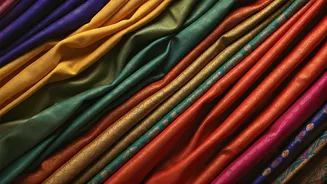
The southern regions of India are renowned for their opulent silk weaves, architectural designs, and intricate zari work. Tamil Nadu's Kanjeevaram sarees
are celebrated for their pure mulberry silk and striking temple borders, exuding a regal aura. In contrast, Kerala offers the delicate Kasavu, a white cotton saree with a shimmering gold edge, embodying understated elegance. Karnataka's Ilkal sarees are distinguished by their vibrant red 'tope teni' pallu, a unique design element. Andhra Pradesh presents the ethereal Uppada Jamdani, a lightweight saree with exquisite zari craftsmanship that drapes beautifully. Rounding off the south, Telangana's Pochampally Ikat is a marvel of geometric precision, crafted from a smooth silk-cotton blend achieved through meticulous tie-dyeing techniques.
Northern Royal Threads
Northern India showcases a blend of regal heritage and practical craftsmanship in its textile traditions. Uttar Pradesh's Banarasi sarees are the epitome of luxury, featuring elaborate gold and silver brocades with floral motifs that command attention. Punjab's Phulkari is a celebration of color and artistry, a vibrant tapestry of intricate floral embroidery. Haryana offers the Resham Dhuria, a comfortable yet festive saree combining silk embroidery with soft cotton. Moving towards the Himalayas, Himachal Pradesh's Kullu Patti sarees stand out with their bold geometric patterns on wool or cotton, often resembling traditional shawl designs. Uttarakhand presents the Panchachuli weaves, offering a refined elegance crafted with delicate precision by women in the Himalayan region.
Western Dyes & Designs
Western India is a global epicenter for exquisite dyeing techniques, showcasing a spectrum from meticulous precision to vibrant fluidity. Rajasthan's Bandhani sarees are iconic for their hyper-saturated, fluid tie-dye patterns, reminiscent of desert landscapes. Gujarat's Patola sarees represent the pinnacle of complexity, a double-ikat masterpiece achieved through mathematical precision that can take months to create. Maharashtra's Paithani silk sarees are luxurious and distinctive, often featuring a peacock motif on the pallu. Goa contributes the Kunbi saree, a breathable red-checked cotton drape that celebrates coastal tribal heritage. Madhya Pradesh offers the exceptionally light and translucent Chanderi silk, an ideal choice for warmer climates, while Chhattisgarh's Kosa Silk provides a unique, slightly coarse texture adorned with indigenous art.
Eastern Storytelling Weaves
The eastern and northeastern regions of India are celebrated for their rich narrative traditions and the use of natural, textured fibers. West Bengal's Baluchari sarees are renowned for their intricate pallus that depict entire scenes from epics like the Ramayana and Mahabharata, turning the saree into a visual story. Bihar's Bhagalpuri Tussar silk offers a rustic, eco-friendly finish, versatile enough for both formal and casual settings. Jharkhand's Tribal Tussar and Odisha's Sambalpuri Ikat, known for its distinctive tie-dyed patterns and natural motifs, both showcase deep connections to indigenous art and culture. The Northeast is a treasure trove of sustainable luxury: Assam's Muga Silk is legendary for its golden sheen that intensifies with washing, and Meghalaya's Eri Silk (peace silk) provides a soft, matte finish with excellent thermal regulation. Arunachal Pradesh's Apatani weaves, Sikkim's Lepcha sarees, Nagaland's Naga Motif drapes with their geometric clan patterns, Mizoram's Puan-inspired sarees with bold stripes, Tripura's Risa-inspired fabrics with tribal accents, and Manipur's Moirang Phee cotton sarees featuring delicate temple-like edge motifs collectively highlight the region's diverse and intricate artistry.