


An Unexpected Hitch
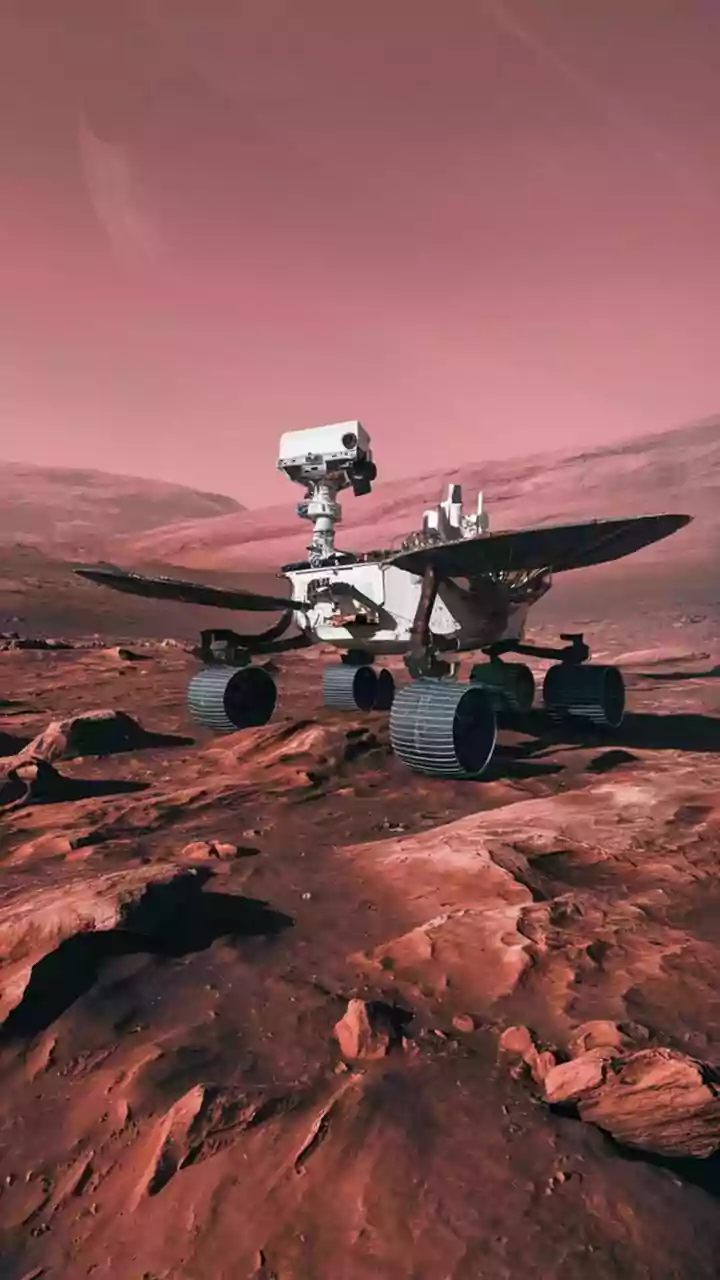
Even the most meticulously planned operations on Mars can encounter unforeseen challenges, and NASA's Curiosity rover recently experienced just that. During
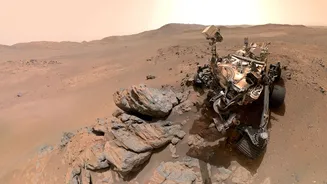
a standard rock analysis, a routine drilling procedure became anything but ordinary when a piece of Martian geology decided to get a little too attached. The rover, a seasoned explorer of the Red Planet for many years, was engaged in sampling a target rock when an anomaly occurred within the drill's intricate machinery. Instead of the expected outcome of finely powdered rock for immediate analysis, a significant fragment behaved in an uncooperative manner. This unexpected behavior led to a situation that required careful observation and intervention from the teams managing the mission millions of miles away on Earth.
The Rock's Tenacious Grip
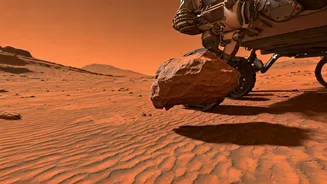
The crux of the issue lay in how the rock fragment interacted with Curiosity's drill sleeve. This crucial component, designed to safeguard the rotating drill bit, is not intended to retain any material. However, a piece of the rock, nicknamed 'Atacama,' clung tenaciously to this sleeve. Post-drilling imagery confirmed the persistent attachment, presenting a curious engineering quandary. The shape and surface texture of this particular Martian rock are suspected to have played a role in its unusual adhesion. When Curiosity attempted its usual arm retraction, the rock remained steadfastly in place, giving the appearance that the rover was attempting to lift a chunk of the Martian surface itself, a testament to its surprisingly strong hold.
Earthbound Problem-Solving
Back on Earth, NASA engineers meticulously analyzed the data transmitted by Curiosity. Each command sent to the rover must be carefully calculated and verified due to the immense distances involved. Initially, the response was measured, involving subtle arm movements and gentle vibrations intended to dislodge the obstruction. Slow, controlled rotation of the drill was also attempted, hoping gravity would do its work. When these passive methods failed to yield results, the team escalated their efforts. Over the following days, they experimented with a range of maneuvers, including altering the arm's angles, introducing slightly more vigorous vibrations, and more pronounced rotations of the drill mechanism. Despite these persistent attempts, the rock remained firmly fixed, presenting a significant challenge to the mission's sampling objectives.
The Breakthrough Maneuver
After several unsuccessful attempts to free the rock using more conventional means, NASA’s engineers devised a more robust strategy. On May 1st, Curiosity executed a dynamic sequence combining aggressive tilting, rapid rotation, and intense vibration of both the robotic arm and the drill assembly. This more forceful approach proved to be the key. The rock fragment finally detached from the drill sleeve and fell back onto the Martian surface. Mission updates noted that the impact caused the fragment to develop a slight crack. This successful resolution marked the end of an unusual engineering episode, and more importantly, confirmed this as the first documented instance of a complete rock becoming lodged in Curiosity's drill sleeve during its extensive operational history on Mars.
Martian Geology's Quirks
Curiosity's sophisticated drilling system is vital for its scientific mission, designed to collect fine rock powder for detailed analysis in its onboard laboratories. These analyses are fundamental to understanding Mars's chemical evolution and the potential for past habitability. However, the diverse nature of Martian rocks presents unpredictable challenges. Unlike the uniformity found in some terrestrial rocks, those on Mars vary greatly in their composition and physical properties. Some are soft and easily layered, while others are notably brittle or possess exceptional density. This inherent variability can, as demonstrated by this incident, lead to unforeseen complications during drilling operations, underscoring the need for continuous adaptation and ingenuity in space exploration.