



The Isolation Gap
As the Artemis II mission propies onward, its Orion spacecraft will soon embark on a journey far beyond Earth's immediate reach. A critical and planned
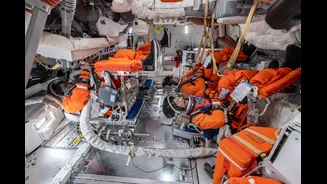
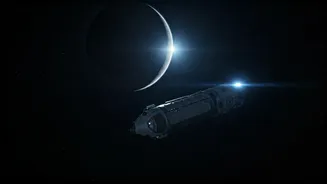
phase of this historic voyage involves a temporary disconnection from mission control, occurring as the spacecraft rounds the far side of the Moon. This period of silence, anticipated to last for approximately 40 minutes, is not a malfunction but a deliberate consequence of celestial mechanics. For the four astronauts aboard – Commander Reid Wiseman, Pilot Victor Glover, and Mission Specialists Christina Koch and Jeremy Hansen – this will represent a profound moment of solitude. While they are trained for such eventualities, the actual experience of being completely cut off, with Earth reduced to a distant celestial body, offers a unique test of the human spirit. This intentional period of isolation harks back to the experiences of past lunar missions, reminding us of the immense psychological and physical challenges inherent in deep space exploration.
Physics of Disconnection
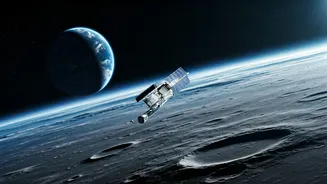
The 40-minute communication blackout faced by the Artemis II crew is a direct result of fundamental physics and orbital mechanics. As the Orion spacecraft journeys behind the Moon, the Moon itself becomes a physical barrier between the spacecraft and Earth. Radio and laser signals, which are the primary means of communication, travel in straight lines. NASA's Deep Space Network, comprised of large antennas on Earth, requires a clear line of sight to maintain contact. When the Moon positions itself directly between Orion and these ground stations, its dense, rocky composition completely obstructs these signals. Unlike Earth's atmosphere, which can sometimes scatter or refract signals, the Moon's solid mass offers no such passage. Therefore, for approximately 40 minutes, all attempts at communication will be rendered futile, creating a complete, albeit temporary, severing of the link to Earth.
Astronauts' Lunar Tasks
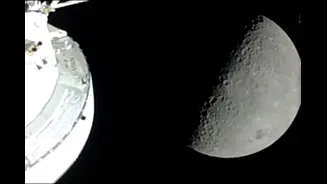
During the 40-minute communication blackout as they navigate the Moon's far side, the Artemis II astronauts will not be idle. This period, though devoid of contact, is designated for specific mission objectives and personal reflection. The crew is expected to conduct important lunar flyby tasks, which may include capturing high-resolution photographs of the lunar surface, analyzing geological features from their unique vantage point, and continuing ongoing research experiments. Beyond these operational duties, the profound silence offers a rare opportunity for introspection. The sight of Earth diminishing to a small, distant point of light can evoke a powerful emotional response, a sense of deep isolation coupled with awe at the vastness of space. This time, free from mission control's constant dialogue, allows for a more personal engagement with the lunar landscape and the cosmic environment.
Echoes of Apollo
The experience of communication loss behind the Moon is not unprecedented in human spaceflight history; it echoes the challenges faced by earlier Apollo missions. During the Apollo 11 mission, for instance, astronaut Michael Collins orbited the Moon solo while Neil Armstrong and Buzz Aldrin walked on its surface. For approximately 48 minutes, Collins was out of contact with Earth. In his writings, he described this period as one of profound solitude, feeling "truly alone" and "isolated from any known life." However, he also found a sense of peace and tranquility in this radio quietude, a welcome respite from the constant communication stream. Artemis II pilot Victor Glover has also spoken about this planned period of silence, suggesting it be viewed as an "opportunity" for prayer, hope, and sending positive thoughts back to Earth, fostering a global sense of unity during the mission's most remote phase.
Earth's Vigil
While the Artemis II crew experiences the profound silence of lunar orbit, a dedicated network on Earth remains acutely aware of their journey. Ground stations, such as the Goonhilly Earth Station in Cornwall, play a crucial role in tracking the Orion spacecraft and relaying vital data. For personnel at these facilities, the moment the spacecraft disappears behind the Moon is met with a mix of apprehension and anticipation. This marks the first time humans have ventured this far from Earth in decades, making the tracking of a crewed mission particularly significant. As the spacecraft re-emerges from behind the lunar body, the successful re-establishment of contact is a moment of immense relief and excitement, confirming the safety of the astronauts. Teams worldwide monitor these critical phases, understanding the inherent risks and celebrating the successful milestones of human exploration.