






Exotic Hues Emerge
In the heart of Haryana, a farmer named Ram Pratap Sharma has become a sensation for cultivating watermelons in an astonishing spectrum of colors. Moving
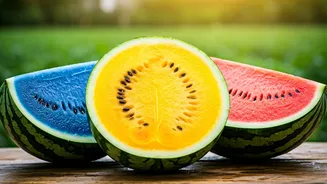
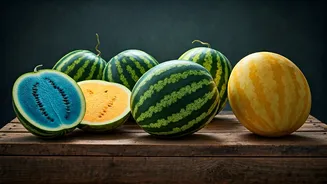
beyond the traditional green rind and red flesh, Sharma's farm now yields fruits with flesh in shades of red, orange, yellow, and remarkably, blue. This unique offering has captured widespread attention, transforming a familiar summer fruit into an exotic delight. Sharma sources premium, specialized seeds from Asian countries, investing significantly, approximately ₹1 lakh per kilogram, to acquire these unique genetic materials. For cultivation across one acre, only about 300 grams of these seeds are needed, enough to support around 6,000 plants. His dedication to innovation has not only brought color to his fields but also significant recognition and financial success, inspiring a new wave of agricultural ambition among his peers.
Sharma's Cultivation Prowess
Ram Pratap Sharma, a 63-year-old farmer from Siwah village in Panipat, Haryana, has revolutionized his agricultural practices, earning him the esteemed Krishi Rattan Award in 2019. After initially assisting with family farming and completing his second year of college, he transitioned to full-time fruit and vegetable cultivation in 2011. He embraced modern techniques such as polyhouses, protective netting, and drip irrigation systems, which were gaining traction locally. His produce now reaches markets in Delhi, Gurgaon, Chandigarh, and Ludhiana, serving industrialists and online retailers. Sharma efficiently manages a team of seven laborers and cultivates over 20 types of vegetables each season, employing intercropping methods. This year, he dedicated 1.5 acres to his vibrant watermelon varieties, while the remaining land was used for spinach, fenugreek, guava, peach, and pomegranate. The strategic location of his farm, close to National Highway-44, enables swift delivery to the Panipat mandi in a mere four minutes, ensuring unparalleled freshness for his customers.
The Rainbow Watermelon Varieties
Sharma's distinctiveness lies in his five special watermelon varieties, which defy conventional expectations. While most are familiar with the standard green-skinned, red-fleshed watermelon, his exceptional offerings present a dazzling array of internal colors, including red, orange, dark yellow, light yellow, and an unexpected blue. These unique fruits are cultivated from premium seeds procured from Thailand and Taiwan. He has also introduced three new cultivars: 'Low Munch', 'Orange Munch', and '24 Carat Gold'. The 'Orange Munch' features a green rind encasing bright orange flesh, while 'Yellow Munch' has a green exterior revealing yellow flesh. The '24 Carat Gold' is particularly striking with its entirely yellow rind and flesh. All these colorful watermelons are being offered to consumers at a competitive price of ₹50 per kilogram, making them accessible to a wider audience.
Financial Harvest and Expertise
The cultivation of these unique colored watermelons is a lucrative venture for Ram Pratap Sharma. He first experimented with Taiwanese seeds on his farm in 2019, and the initiative proved to be highly successful. The cost of cultivating one acre of watermelon amounts to approximately ₹2 lakh, yet it generates a substantial revenue of roughly ₹6 lakh. After accounting for all expenses, Sharma realizes a net profit of about ₹4 lakh per acre. This impressive financial outcome has garnered praise from agricultural experts. Ranbir Singh, Haryana's Director General of Horticulture, describes Sharma as a farmer who is "hardworking, innovative and progressive," acknowledging his ability to achieve high earnings from a small landholding through advanced technology and farming patterns. Rakesh Kumar, Deputy Director at the Vegetable Centre of Excellence in Gharaunda, points out that Panipat's sandy loam soil is ideal for such cultivation, further supported by government subsidies of up to 85% for essential tools like drip irrigation systems. Sharma advocates that with diligent effort, a farmer can comfortably earn ₹2 lakh annually per acre from vegetables, complemented by fruit farming on the same land.