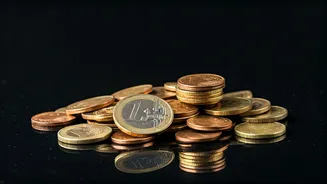

The Euro's Reach
The Euro, the official currency of the Eurozone, isn't confined solely to the member states of the European Union. Several nations outside the EU have
made the strategic decision to adopt the Euro for their economic transactions. This move is not just a matter of convenience; it represents a profound choice with implications for national economies. These countries have essentially foregone their own independent monetary policies, opting instead for the financial stability and credibility associated with the Euro. The reasons vary, including close economic ties to Eurozone countries, the desire for stability, and practical considerations related to trade and tourism. Their decisions reflect a complex interplay of politics, economics, and international relations.
Vatican City's Choice
Vatican City, a sovereign city-state within Rome, Italy, is a prime example of a non-EU country using the Euro. Given its geographical location and its close economic and financial ties with Italy, the adoption of the Euro was a logical step. As a city-state, Vatican City does not have its own currency. The Vatican uses the Euro under an agreement with the European Union, permitting it to issue its own Euro coins, which are easily recognized and accepted throughout the Eurozone. This allows for seamless financial transactions and streamlines its economic interactions with the outside world. This arrangement simplifies financial transactions and allows the Vatican City to benefit from the stability of the Euro.
Monaco's Economic Ties
Monaco, a principality on the French Riviera, is another nation that has adopted the Euro. Monaco's relationship with France is a key factor in its currency choice. Monaco has a monetary agreement with France, and the Euro is the official currency. The principality uses Euro coins, with the right to issue its own coins, similar to Vatican City. Monaco's adoption of the Euro reflects its deep integration with the French economy and the convenience for its thriving tourism and financial sectors. This arrangement not only simplifies daily transactions but also helps to maintain stability in a region known for its economic dynamism. The use of the Euro further strengthens Monaco's ties with the European continent.
San Marino's Currency Strategy
San Marino, a small republic enclaved by Italy, also benefits from the Euro. Similar to Monaco and Vatican City, San Marino has a currency agreement with the EU. The country adopted the Euro to facilitate economic integration with Italy and the broader European market. San Marino's proximity to Italy makes the Euro a practical choice. The economic landscape of San Marino is therefore intertwined with that of its Italian neighbor. This strategic move supports the local economy, and simplifies financial operations. San Marino can also mint its own Euro coins, underscoring its autonomy within the framework of the currency union. The use of Euro in San Marino enhances trade and stability.
Andorra's Financial Adoption
Andorra, a principality located in the Pyrenees Mountains between France and Spain, utilizes the Euro. Andorra, previously using its own currency, now relies on the Euro. The adoption of the Euro brought Andorra's financial system in line with its European neighbors and helped facilitate economic activities in the region. This financial integration enhances Andorra's banking sector, and supports economic activities. Andorra has found the Euro to provide stability and confidence, promoting its role as a financial hub. The use of the Euro is part of Andorra's broader strategy to align itself with the financial standards of the European Union. This benefits tourism and commerce.
Montenegro's Unilateral Approach
Montenegro's case is unique among these nations. It adopted the Euro unilaterally, without an official agreement with the European Union. Montenegro began using the Euro in 2002 to foster economic stability and control hyperinflation, a problem the country struggled with in the late 1990s and early 2000s. Although Montenegro's adoption of the Euro has brought stability and streamlined financial dealings, it does not have the same formal agreement as Vatican City, Monaco, San Marino, or Andorra, which means that the European Central Bank does not guarantee Montenegro's financial security. The move was designed to rebuild the economy, but it has left Montenegro without the ability to implement its own monetary policies. The Euro is a symbol of financial stability.