







The Venus Flytrap
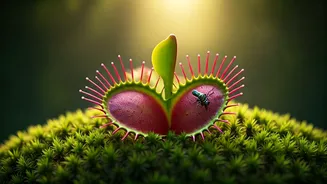
The Venus flytrap stands as the most iconic of carnivorous flora, renowned for its dramatic adaptation. Its specialized leaf structures function as ingenious
snap traps. When an unsuspecting insect makes contact with the sensitive trigger hairs located within the trap, the leaf edges rapidly snap shut, ensnaring the prey. While primarily feeding on insects, these plants have also been observed capturing other minuscule creatures. This rapid closure mechanism is a testament to the plant's evolved predatory behavior in environments where soil nutrients are scarce, allowing it to supplement its diet effectively.
The Pitcher Plant
Pitcher plants employ a passive yet effective trapping method, utilizing modified leaves shaped into deep, liquid-filled pitchers. These alluring structures often produce nectar, acting as a irresistible lure for insects. Once attracted, insects venture too close and inevitably slip into the pitcher, where they drown in the digestive fluid. Some species, particularly within the Nepenthes genus, are significantly larger and capable of capturing not only insects but also small vertebrates like rodents and even birds, demonstrating a broader predatory range.
The Sundew's Sticky Grip
Sundews captivate their prey with a mesmerizing display of glistening tentacles covering their leaves, resembling dewdrops. These sticky glands secrete a viscous fluid that ensnares any small insect that lands upon them. Once an insect is trapped, the sundew's leaf slowly curls around the unfortunate victim, pressing it against the digestive enzymes. This deliberate movement ensures that the insect is effectively immobilized and broken down for nutrient absorption, a crucial survival mechanism for sundews thriving in waterlogged, acidic soils.
Bladderwort's Suction Power
Bladderworts are remarkably swift aquatic or terrestrial plants that possess a unique predatory strategy. They utilize an intricate system of tiny, hollow bladders filled with water. When a small organism, such as insect larvae or water fleas, brushes against the bladder's trigger hairs, a trapdoor mechanism opens, and the bladder rapidly expands, creating a vacuum that sucks the prey inside. This instantaneous suction is one of the fastest in the plant kingdom, making bladderworts highly efficient hunters in aquatic habitats and damp soils.
Butterwort's Gentle Trap
Butterworts present a more delicate approach to carnivory, featuring broad, soft leaves that are coated in a sticky mucilage. These leaves act as flypaper, effectively trapping tiny flying insects like gnats and fruit flies that alight upon them. Once an insect becomes stuck, the leaf gradually rolls or curls inwards, further securing the prey. Digestive enzymes are then secreted to break down the insect, allowing the butterwort to absorb essential nutrients. These small, elegant plants are commonly found in moist environments where their preferred tiny prey is abundant.
The Cobra Lily
The Cobra Lily, also recognized as the California pitcher plant, boasts a distinctive hooded appearance, uncannily resembling a poised cobra. Its intricately shaped structure serves to lure insects inside. Once within the pitcher, escape becomes incredibly difficult due to the slippery interior surfaces. This striking carnivorous plant thrives in the boggy, nutrient-deficient regions of northern California and southern Oregon, where its unique trapping mechanism is essential for survival.
Waterwheel Plant's Speed
The Waterwheel Plant is a rare and endangered aquatic species known for its ingenious underwater traps. It features small, modified leaves arranged in a circular pattern, resembling a waterwheel. These leaves bear tiny traps that snap shut with astonishing speed when small aquatic organisms, such as mosquito larvae or other minuscule creatures, trigger them. As it floats freely on the water's surface, the waterwheel plant can move with currents, ensuring its traps encounter potential meals. Its rapid closing mechanism is crucial for capturing fast-moving aquatic prey.