






Advanced Crew Monitoring
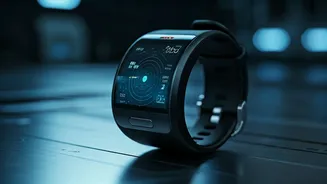
As humanity prepares to return to the Moon with the historic Artemis II mission, a sophisticated piece of wearable technology, the ARCHeR wristbands, will
be integral to astronaut well-being. These advanced devices are meticulously engineered to provide a comprehensive overview of the crew's health and performance throughout their lunar expedition. The ARCHeR, which stands for Advanced Resilient Cognitive Health and Environmental Recorder, is packed with an array of sophisticated sensors. These sensors are designed to continuously track vital physiological metrics such as heart rate, blood oxygen saturation, and core body temperature. Furthermore, they are capable of detecting indicators of stress, offering mission control real-time insights into how each astronaut is coping with the demands of deep-space travel. This constant stream of data empowers flight controllers to swiftly identify and address any emergent health issues, thereby significantly enhancing astronaut safety and mission success during this monumental voyage beyond Earth's orbit. The technology represents a significant leap in ensuring human resilience in the challenging environment of space exploration.
Environmental Safeguards
Beyond monitoring the internal state of the astronauts, the ARCHeR wristbands are also equipped to observe the external environment. These integrated environmental sensors are designed to detect subtle yet critical changes in atmospheric pressure, monitor radiation levels, and assess other key factors within the spacecraft and during crucial extravehicular activities (EVAs) on the lunar surface. This proactive environmental surveillance is paramount for guaranteeing the safety of the astronauts as they operate in the unforgiving and potentially hazardous conditions of the Moon. The data gathered from these environmental sensors provides an essential layer of protection, allowing for immediate adjustments to procedures or protocols if any environmental parameters exceed safe thresholds. This dual capability—monitoring both the astronaut and their surroundings—underscores the holistic approach NASA is taking to ensure the crew's safety and the overall success of the Artemis II mission, setting a new standard for astronaut support technology.
Technological Innovation
The underlying technology powering the ARCHeR wristbands exemplifies NASA's relentless pursuit of innovation in space exploration. Crafted from cutting-edge materials and utilizing sophisticated algorithmic processing, these wristbands are built to endure the extreme rigors associated with space travel, including significant temperature fluctuations, vacuum conditions, and radiation exposure. Their design prioritizes both resilience and practicality, featuring a compact and lightweight form factor that ensures they do not hinder the astronauts' range of motion or overall comfort during critical mission phases. This meticulous engineering ensures that the technology itself becomes a seamless extension of the astronaut, rather than a cumbersome addition. The development process involved extensive testing and refinement to meet the stringent requirements of deep-space missions, paving the way for future advancements in astronaut-worn technology that enhances both performance and safety.
Future Mission Impact
The valuable data meticulously collected by the ARCHeR wristbands extends far beyond the immediate needs of the Artemis II mission; it is a crucial stepping stone towards a profounder understanding of human physiology in extraterrestrial environments. This amassed knowledge will be indispensable for planning and executing future long-duration missions, including the ambitious goal of sending humans to Mars. By studying how astronauts' bodies and minds adapt to the unique stressors of lunar missions, NASA can develop more effective countermeasures and optimize mission parameters for extended stays in deep space. The insights gained will inform the design of future spacecraft, life support systems, and crew support protocols, ultimately contributing to the long-term sustainability of human presence beyond Earth. The ARCHeR wristbands, therefore, are not just monitoring tools but vital instruments for unlocking the next frontier of human space exploration.