




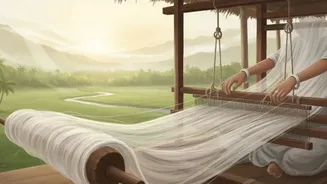

The Digital Pace vs. Craft
The fashion industry is undergoing a rapid transformation, driven by digital technologies that allow for instantaneous creation and rapid trend cycles.
Garments are often conceptualized and designed as 'digital twins' using advanced software, mapping intricate patterns and even embedding electronics for interactive elements, exemplified by complex sequined dresses or runway performances where clothing is applied directly onto the body. This acceleration, characterized by fluid design and swift execution, positions the hand-woven textile as a critical counterpoint. Far from a simple opposition of old versus new, it signifies a deliberate negotiation of value. In an era where artificial intelligence can generate countless designs in moments, the tangible qualities of handwoven fabric—its weight, drape, and unique character—are emerging as the ultimate markers of luxury, offering a profound sensory experience absent in purely digital creations.
Automation's Speed Trap
The advent of algorithm-led trend forecasting has fundamentally reshaped production cycles, demanding a speed that traditional manual looms cannot replicate. While this rapid pace benefits mass-market logistics, it poses a significant challenge to heritage weavers whose craft, like Jamdani or Paithani, involves complex, cerebral labor that is often misconstrued as inefficiency. This relentless focus on speed comes at the cost of sensory richness; a purely digital fashion economy lacks the essential tactile dimension. Renowned designer Anita Dongre highlights that while technology enhances efficiency in design and sampling, textiles born from the hand operate within a distinct value system. Their worth is intrinsically tied to the time invested, human skill, and the richness of cultural memory embedded within them. The subtle imperfections found in hand-drawn lines or the organic spread of hand-blocked dyes are precisely what distinguish authentic craft in an age of machine-perfected production, serving as tangible evidence of human creation.
The Loom's Ancient Logic
Viewing the loom as a rudimentary tool overlooks its profound historical significance in fashion technology. The operational principles of the Jacquard loom, for instance, laid the groundwork for binary computing, with the warp's movement mirroring the original '0' and '1' states. Contemporary high-tech fashion, in essence, revisits these foundational concepts, albeit at a greatly accelerated rate. The hours invested in creating a handwoven Banarasi textile are not merely a cost but a material element that imbues the fabric with density and reflects its heritage. For craft communities like Tilfi Banaras, the loom's rhythm acts as a conduit for cultural memory, a unique 'language of the hand and the heart' that challenges the notion that speed equates to progress. The danger of an unchecked digital sprint is the erosion of this distinct language, flattening nuanced regional identities into a digital-first aesthetic that prioritizes screen appearance over tactile sensation.
Digital Tools, Hybrid Craft
The fashion design process is evolving, moving from physical swatches and sketches to digital platforms where garments are conceptualized, mapped, and simulated before any physical material is used. This upstream shift into digital spaces allows for extensive testing and refinement. Collections, like those showcased at Paris Fashion Week with garments responding dynamically to light, demonstrate how fabric can function as an interface, with technology integrated from the outset of design. Rather than a replacement for craft, technology is positioned as a strategic partner. Tools such as 3D sampling and virtual prototyping streamline the development process, reducing the need for numerous physical prototypes. This allows handwoven textiles to be incorporated later in the design cycle, with greater purpose and intention. Consequently, craft is elevated within the design hierarchy, reserved for moments that require depth, texture, and human artistry, becoming a deliberate point of arrival rather than an initial production step.
Economic Viability for Artisans
Handwoven textiles are experiencing a resurgence in visibility, particularly among younger audiences through social media, where their stories and cultural significance are highlighted. However, this increased awareness needs to translate into tangible support for artisans. For craft to truly endure, it must function as a sustainable livelihood, not as charity. This necessitates a shift from sporadic craft collaborations to consistent, long-term partnerships between design houses and artisan communities. Financial stability is achieved when artisans are recognized as creative collaborators within the value chain, rather than simply suppliers. When consumers grasp the extensive time and mastery involved in creating a handwoven textile, they are more likely to embrace a 'slow luxury' price point that accurately reflects the true value of human skill and dedication, ensuring economic dignity for the craftspeople.
The Future: A Bilingual Heritage
As fashion continues its accelerated digital trajectory, the relevance of handwoven textiles is not diminishing but intensifying. The coming decade points towards a recalibration rather than a replacement—a hybrid system where technology manages efficiency, scale, and accessibility, while handwoven textiles retain their status as bearers of profound meaning, identity, and uniqueness. Their future lies less in mass production and more in the realm of haute couture, anchoring a more deliberate fashion economy that prioritizes depth over volume. In this evolving landscape, handwoven textiles are becoming 'bilingual,' speaking both the language of tradition through inherited techniques and human touch, and the language of data to maintain visibility and viability in the contemporary market. The ultimate luxury in an increasingly automated world is not instant gratification, but the enduring narrative and the palpable human connection embedded in every hand-stitched thread.