



Celestial Alignment Explained
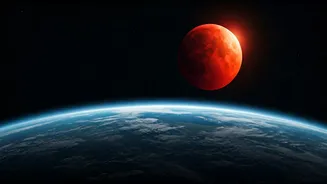
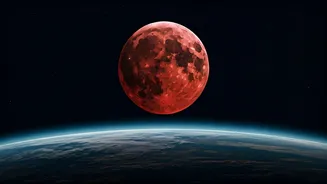
On March 3, 2026, the cosmos will align for a total lunar eclipse, a captivating event where Earth positions itself directly between the Sun and the Moon.
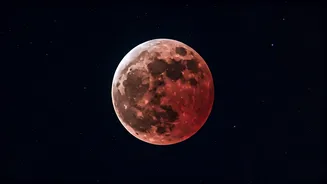
This astronomical arrangement causes Earth's shadow to fall upon the lunar surface, obscuring the Moon from direct sunlight. While lunar eclipses occur with some regularity, a total lunar eclipse is a more profound and visually striking phenomenon. It's an opportunity for sky gazers to witness a dramatic transformation in the Moon's appearance, a process that unfolds over a defined period, offering a unique glimpse into celestial mechanics.
The 'Blood Moon' Phenomenon
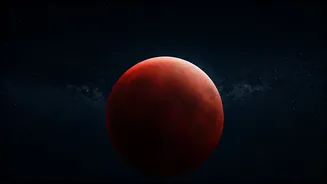
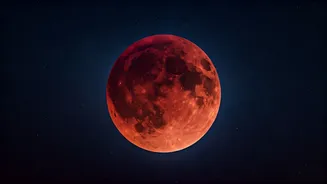
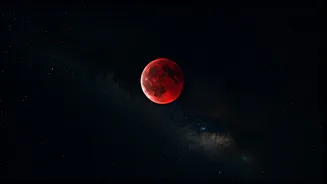
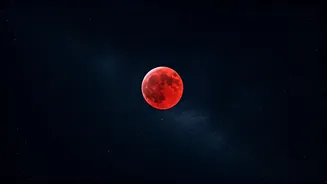
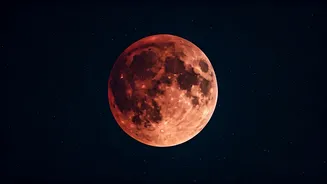
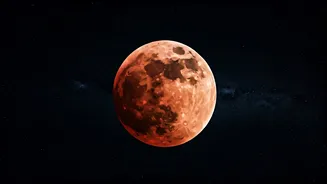
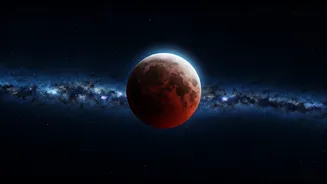
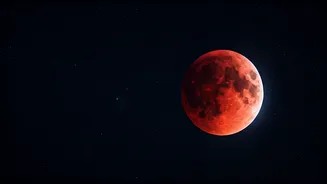
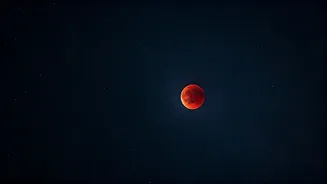
The mesmerizing reddish color, earning it the 'Blood Moon' moniker, arises from how Earth's atmosphere interacts with sunlight during the eclipse. As the Earth blocks direct solar rays, a portion of sunlight still manages to pass through our planet's atmosphere. This light refracts, bending its path, and while shorter blue wavelengths are scattered away, longer red and orange wavelengths persist and reach the Moon. This selective filtering is akin to a cosmic sunset projected onto the lunar surface, imbuing it with its characteristic deep, crimson glow. It's a beautiful demonstration of atmospheric optics on a grand scale.
Viewing in India
For sky watchers in India, the total lunar eclipse on March 3, 2026, will be a 'moonrise eclipse' event. This means that by the time the Moon ascends above the horizon in various parts of the country, the eclipse will have already commenced. Consequently, the initial phases of the eclipse won't be visible. The exact timing of moonrise varies across cities like Delhi (06:22 PM), Lucknow (06:02 PM), Chennai (06:21 PM), and Hyderabad (06:26 PM), and so will the duration for which the eclipse is observable. The maximum eclipse phase is expected between 06:33 PM and 06:40 PM, with the eclipse concluding at 06:47 PM.
Global Viewing Times
While India experiences a partial view due to the moonrise timing, other regions will have different viewing opportunities for the March 3, 2026, total lunar eclipse. For instance, in Los Angeles, the event will be visible around 3:04 AM. Those in Denver can expect to see it at 4:04 AM, while Chicago and St. Louis will experience it at 5:04 AM. Further east, New York and Washington D.C. will witness the eclipse starting at 6:04 AM. These varied timings highlight the global nature of this celestial event, offering different perspectives and viewing windows across continents.