



Fabric Revival Narrative
Rahul Mishra's 'White Gold' collection for Lakmē Fashion Week x FDCI marked a deliberate return to his foundational materials, specifically Kerala cotton
mundum neriyatum and delicate Chanderi. This conscious choice echoed his debut GenNext collection from 2006, which prominently featured these same handloom textiles in reversible designs. Mishra candidly admitted that his team found the handling and draping of these traditional fabrics a challenge, given their extensive experience with embroidery and couture. This led him to personally engage with the textiles, guiding their transformation into a contemporary ready-to-wear aesthetic for his AFEW line. The collection's essence lies in this thoughtful re-engagement with his craft's origins, showcasing a deep respect for heritage while pushing design boundaries.
Textile Innovation Showcase
The 'White Gold' collection was a testament to collaboration and textile innovation, stemming from a year-long partnership with Supima and Cotton USA. A significant highlight was the rekindled relationship with master weaver Hukum Kohli from Chanderi. Kohli, who supported Mishra in his early career, collaborated on this line, ingeniously merging Supima cotton yarn with silk. This fusion revitalized the traditional 'ek naal' kadwa weaving technique, resulting in a novel Chanderi fabric described by Mishra as exceptionally soft, lightweight, and akin to 'woven air.' This innovative approach to Chanderi, alongside the light Kerala cottons and the added substance of Supima denim, created a diverse textural landscape for the tailored pieces. The collection's narrative was further enriched by Mishra's fascination with entomology, manifesting in dragonfly and bug motifs.
Nature's Motifs Embellish
The 'White Gold' runway buzzed with life, featuring an abundance of insect and floral motifs that added a whimsical yet meaningful layer to the collection. Beyond a large ladybug and numerous dragonflies adorning the cotton-field runway, delicate woven motifs and intricate hand-embroidery brought winged creatures and crawlies to life on various garments and accessories. These 'protectors' of the cotton crop were complemented by marigolds and mustard flowers, traditionally planted alongside cotton to naturally deter pests. These blooms were beautifully rendered through hand-painted prints and exquisite embroideries, further emphasizing the collection's deep connection to the natural world and the agricultural origins of its primary materials.
Design Highlights & Contrasts
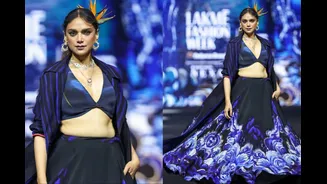
The collection opened with a strong presentation of pure Kerala cotton pieces, distinguished by organic nips, tucks, and folds that harked back to Mishra's earlier, minimalist aesthetic. The ethereal Chanderi garments, adorned with dragonfly motifs, masterfully balanced structure and fluid drape. A particularly striking segment featured a navy-blue ensemble where tailored suiting and corsetry seamlessly integrated with sheer Chanderi, creating a captivating interplay of solid and translucent elements. The menswear also stood out, showcasing sharp-shouldered jackets and flared trousers that combined multi-stripes with textured florals, and denim pieces imbued with a vintage charm. These thoughtfully designed pieces offered moments of nostalgic beauty.
Reflective Moments & Evolution
Within the 'White Gold' collection, the quieter, more understated pieces resonated with a profound sense of nostalgia, reflecting the purity of Mishra's initial design aspirations, evident in the subtle shimmer of Chanderi motifs and the graceful folds of pleats. However, certain bolder elements, such as heavily sequined garments, shiny corsets, and a token swimsuit, felt somewhat extraneous, disrupting the collection's cohesive narrative flow. Similarly, the checkered overlays presented on bodysuits appeared unresolved. The collection, while rich in ideas, seemed to grapple with an overabundance of concepts, suggesting a need for more focused editing and refined styling. This leaves an impression that the AFEW line is still in its developmental phase, striving to define a sharper, more streamlined identity that harmonizes the brand's Indian heritage with its global aspirations, hinting at future refinements.