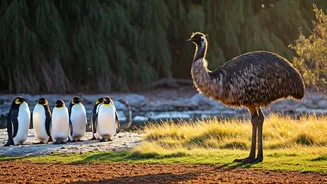







The Majestic Ostrich
The ostrich, a titan among birds, claims the title of the world's largest avian. Hailing from Africa, this magnificent creature has forgone the ability
to fly, a trait compensated by its extraordinary terrestrial prowess. Its formidable legs are built for speed, allowing it to cover vast distances rapidly, while its wings, though incapable of lift-off, play a crucial role in maintaining balance during sprints and are used in elaborate courtship displays. This adaptation showcases a brilliant evolutionary trade-off, prioritizing ground mobility and social signaling over aerial escapades.
Australia's Swift Emu
Journeying to the land Down Under, we encounter the emu, another sizable bird that has embraced a life on solid ground. Much like the ostrich, the emu boasts powerful legs, enabling it to traverse its native Australian landscapes with impressive speed and endurance. Its wings are vestigial in terms of flight, serving instead as aids for balance, particularly when navigating uneven terrain or during their impressive bursts of speed. The emu's existence is a testament to how terrestrial locomotion can be a highly effective survival strategy for large birds.
New Zealand's Enigmatic Kiwi
From the lush forests of New Zealand emerges the kiwi, a truly unique and curious flightless bird. Characterized by its shaggy, hair-like feathers, sturdy legs, and a compact physique, the kiwi has evolved with significantly reduced wings. Its entire being is geared towards a terrestrial existence, spending most of its time foraging on the forest floor. This adaptation makes the kiwi a master of its ground-level environment, highlighting how specialized adaptations can lead to success even in a world dominated by flying avians.
The Ocean's Penguin
Shifting our focus to the aquatic realm, we find the penguin, a seabird that has masterfully traded the skies for the sea. Primarily found in the Southern Hemisphere, penguins are exceptional swimmers, transforming their wings into powerful flippers that propel them through the water with remarkable agility. Their streamlined bodies and dense bones are perfectly suited for diving and navigating frigid aquatic environments, showcasing a profound adaptation for marine life rather than aerial flight.
The Striking Cassowary
Residing in the verdant Australo-Papuan region, the cassowary is a large and visually striking flightless bird. It is distinguished by its robust build, formidable legs, and a lifestyle deeply rooted on the forest floor. While flight is not within its capabilities, the cassowary is exceptionally well-equipped for moving through dense jungle environments. Its distinctive appearance and powerful physique make it one of the most unique and recognizable birds on the planet.
South America's Speedy Rhea
Native to the open plains of South America, the rhea is a large flightless bird that shares a kinship with the ostrich and emu. This relative newcomer to our list is built for speed, boasting long legs and a lightweight frame that make running its primary defense mechanism against predators. Its design is optimized for rapid terrestrial movement, illustrating how agility and evasiveness can be key survival traits for flightless species in open habitats.
Critically Endangered Kakapo
Rounding out our list is the kakapo, an extraordinary flightless parrot found exclusively in New Zealand. This nocturnal and ground-dwelling bird breaks the mold of typical parrots. Tragically, the kakapo is critically endangered, making it an incredibly rare sight. Its unique adaptations and vulnerable status underscore the delicate balance of nature and the importance of conservation efforts for such specialized species.