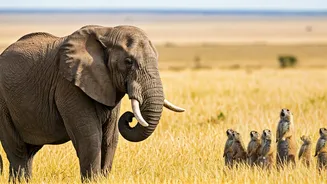








Echoes Across Continents
African elephants possess a remarkable ability to communicate over vast distances using infrasonic rumbles. These deep, low-frequency sounds travel for
several kilometers through both the ground and the air, allowing entire herds to maintain contact even when separated by significant geographical divides. This sophisticated communication network serves as a vital tool for coordination, enabling them to share information about food sources, potential dangers, and maintain social cohesion. The ability to utilize these subtle vibrations underscores the complex social structures and survival strategies of these magnificent creatures, showcasing a communication method far beyond our everyday perception. It highlights how they harness the very earth and atmosphere to foster connection and ensure the safety of their family groups.
Rainforest Serenades
The indri, a rare and melodious lemur species, captivates with its hauntingly beautiful songs that resonate through the dense rainforest canopies. These vocal performances are not solitary affairs; family groups engage in synchronized choruses, a behavior that serves multiple crucial purposes. This collective singing strengthens the intricate bonds within family units, reinforcing their social connections and mutual reliance. Furthermore, these powerful vocalizations act as territorial markers, clearly defining the boundaries of their domain and deterring potential rivals. The indri's melodic communication is a testament to the adaptive evolution of vocalizations for social cohesion and territorial defense in their unique forest environment.
Nighttime Booming
The critically endangered kakapo, a unique flightless parrot, employs a distinctive communication strategy during its mating season. Males produce deep, resonant booming calls that carry impressively over long distances through the nighttime forests. This acoustic signal is primarily designed to attract females, guiding them through the darkness to locate potential mates. The effectiveness of these booming calls in navigating the dense nocturnal environment highlights an extraordinary adaptation for reproductive success. It’s a fascinating example of how specialized vocalizations can play a pivotal role in species survival, especially for those facing significant conservation challenges.
Arctic Soundscapes
Often referred to as the 'unicorns of the sea,' narwhals navigate the frigid Arctic waters using a rich repertoire of clicks, whistles, and pulsed sounds. These diverse vocalizations are essential for their survival in a challenging underwater environment. They utilize these complex acoustic signals for echolocation, enabling them to efficiently locate prey and avoid obstacles in the dimly lit depths. Beyond navigation and foraging, these sounds are vital for social interaction within their pods, facilitating communication related to group movements, safety, and social bonding. The narwhal's sophisticated sound production paints a picture of intricate communication in a world dominated by water and ice.
Prairie Dog Lexicon
Prairie dogs boast one of the most sophisticated 'languages' observed in the animal kingdom. Their alarm calls are remarkably detailed, capable of conveying specific information about approaching predators. Remarkably, these calls can distinguish between different types of threats, such as a hawk versus a human intruder. Even more astonishing is their ability to communicate the predator's size, its speed of approach, and its direction of travel. This complex system of encoded vocalizations provides crucial, life-saving information to the colony, demonstrating an advanced level of communication that allows for coordinated defensive actions and enhanced survival rates.
Sifaka Signals
Sifakas, a distinctive lemur species exclusively found in Madagascar, employ a multifaceted approach to communication. Their signals encompass a blend of vocal calls, the strategic use of scent markings, and expressive body language. This diverse communication toolkit is instrumental in coordinating their movements as they traverse the forest canopy. It also plays a vital role in maintaining the cohesion and stability of their family groups. The combination of auditory, olfactory, and visual cues allows them to navigate their arboreal environment effectively and sustain strong social structures essential for their survival.