





Introducing Green Hydrogen Cooking
In response to the growing concerns surrounding LPG availability, an Indian company has unveiled a remarkable cooking appliance that operates without traditional
gas. This innovative stove is designed as a plug-and-play unit, capable of producing green hydrogen right when it's needed, utilizing only water and a minimal amount of electricity. This promises a cooking experience that is not only environmentally friendly, emitting zero pollutants, but also operates with remarkable quietness. Currently, this cutting-edge technology is being positioned for commercial and institutional applications, representing a significant stride towards integrating sustainable energy solutions into our kitchens and beyond.
Advanced Hydrogen Stove Technology
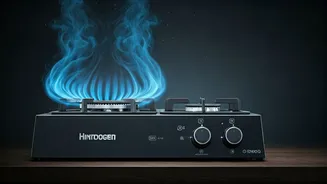
This distinctive gas stove operates entirely on green hydrogen, featuring a dual-burner design. Constructed from stainless steel and designed for tabletop placement, it initiates cooking through manual ignition, mirroring the user interface of conventional stoves but diverging significantly in its underlying operational mechanism. The innovation, attributed to a firm named Greenvize, incorporates a built-in proton exchange membrane (PEM) electrolyzer. This clever integration allows the stove to generate hydrogen directly from ordinary water, eliminating the need for cumbersome gas cylinders or extensive piping networks. Each unit requires a mere 100 ml of distilled or RO water, coupled with just 1 kWh of electricity, to facilitate up to six hours of continuous cooking. While both induction and this hydrogen system consume electricity, their efficiencies and practical applications differ. Induction cooktops typically draw between 1.5 to 2 kW per burner, whereas the hydrogen system uses approximately 1 kWh. A notable advantage is its compatibility with all types of cookware, a stark contrast to induction stoves which necessitate specialized magnetic pots and pans.
Zero-Emission, Quiet Operation
A primary advantage of this advanced gas stove is its commitment to environmental sustainability, boasting a zero-emission cooking process. This means that during operation, it releases no carbon monoxide or any visible smoke, contributing to cleaner air quality in indoor spaces. Furthermore, the stove operates with exceptional quietness and without any disruptive vibrations, making it an ideal choice for environments where a peaceful and clean atmosphere is paramount. The only discernible by-product generated during its functioning is water vapor, reinforcing its status as an eco-friendly alternative to conventional cooking methods. This focus on clean and silent operation addresses key concerns about air pollution and noise disturbance often associated with traditional kitchen appliances.
Commercial and Household Potential
While the design inherently supports integration into home kitchens, the current strategic focus for this hydrogen stove is on broader applications. It is undergoing trials and evaluation for use in various communal settings such as community kitchens, institutional canteens, and government-led clean-energy initiatives, alongside industrial and institutional kitchens. Although it is a significant investment at approximately Rs 1,50,000 per unit, it is not yet targeted for mass adoption by individual households. Rather, it's being promoted as a pilot project, primarily intended for kitchens operating at a larger scale. It's unlikely to displace LPG in domestic settings in the immediate future, but it undeniably represents a forward-thinking approach to cooking technologies. Experts believe that if its scalability for mass production can be achieved, it holds the potential to deliver substantial benefits to both society and the environment. Successful testing in commercial kitchens could herald a revolution in the culinary world, paving the way for a more sustainable future of cooking.