





Rain's Awakening Call
Imagine the gentle sound of rain, a soothing melody that might be more than just an auditory experience for us. For tiny seeds buried deep in the earth,
this familiar patter could signal a crucial moment: the time to grow. Groundbreaking research conducted by scientists at the Massachusetts Institute of Technology (MIT) proposes that plant seeds can indeed perceive the sound of rain. This revelation, published in the journal Scientific Reports, offers the first direct evidence that seeds and seedlings possess the ability to sense natural sounds, potentially impacting their survival by initiating germination at an accelerated pace when exposed to these vibrations.
Sound Waves Stirring Life
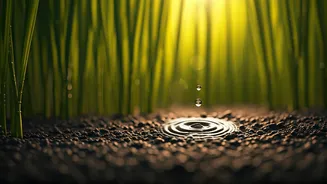
The MIT engineers' experiments with rice seeds have unveiled a remarkable connection between the sound of falling rain and seed germination. They discovered that the acoustic vibrations generated by water droplets effectively coaxed dormant seeds into activity, leading to a significantly faster germination rate compared to seeds kept in silence. Professor Nicholas Makris, a lead author of the study, explained that the energy carried by rain sounds is substantial enough to promote growth. He and co-author Cadine Navarro hypothesize that these rain-induced vibrations may be similar to those produced by other natural events, like wind, prompting their ongoing research into what other natural sounds and vibrations plants might perceive. This suggests a sophisticated sensory system within plants, enabling them to react to their environment in ways we are only beginning to understand.
Plant Perception Mechanisms
Plants, often perceived as passive organisms, exhibit a surprisingly high degree of environmental awareness. Over millennia, they have evolved intricate mechanisms to detect and respond to various stimuli for their survival. For instance, the sensitive Mimosa pudica plant recoils at the slightest touch, while others retract when exposed to noxious odors. Most plants exhibit phototropism, the ability to grow towards light sources. Furthermore, plants are known to sense gravity. The curiosity that led to this rain-sound discovery was sparked when co-author Cadine Navarro inquired about seeds and sound with Professor Makris, whose work spans acoustics. They questioned if sound vibrations alone could dislodge statoliths (dense particles within plant cells involved in gravity sensing) and encourage germination. Their investigation delved into historical acoustic measurements of rain underwater, revealing that water's density amplifies sound pressures significantly, likening the experience for a seed near an impact to being close to a jet engine in the air.
Experimental Revelations
To test their hypothesis, the researchers undertook extensive experiments involving approximately 8,000 rice seeds immersed in shallow water. They meticulously controlled variables such as droplet size and impact height to simulate different rain intensities, from a light drizzle to a heavy downpour. Using hydrophones, they precisely measured the acoustic vibrations produced. The results were compelling: seeds exposed to the sound of falling water germinated between 30% and 40% faster than the control group. Intriguingly, seeds situated closer to the water's surface demonstrated a greater sensitivity to the droplet sounds, exhibiting faster growth compared to those located deeper or further away. This reinforces the idea that the sound-induced vibrations act as a trigger, and the depth of submergence influences the intensity of this perceived signal. Professor Makris noted that the same cellular mechanisms used for sensing gravity might also enable seeds to perceive beneficial soil or water depths by listening to the rain, adding a new layer of meaning to traditional observations about the seasons.