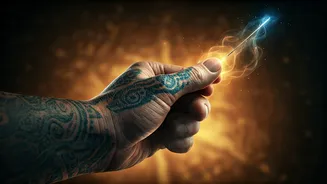




Timeless Markings: Early Ink
The practice of adorning the skin with indelible marks stretches back far beyond recorded history, with evidence pointing to humans engaging in tattooing
as early as 5,000 years ago. These ancient skin modifications were not mere decorations but held significant meaning for early societies. The most compelling proof comes from the remarkable discovery of Ötzi the Iceman, a naturally preserved mummy found in the Alps. His body, dated to approximately 3300 BCE, displays over sixty distinct tattoos. These markings are predominantly simple lines and dots, suggesting a rudimentary yet deliberate approach to this ancient art form. The placement of these tattoos on Ötzi's body, particularly near joints and areas associated with discomfort, has led researchers to theorize that they served a therapeutic purpose, potentially representing an early form of medical treatment akin to acupuncture. This suggests that from its very inception, tattooing was intertwined with human health and well-being, not solely an aesthetic pursuit.
Egyptian Adornments: Sacred Skin
Ancient Egypt also provides compelling evidence of tattooing, with mummies dating back to around 2000 BCE revealing inked skin. These ancient Egyptian tattoos were predominantly found on female remains, hinting at specific cultural roles or beliefs associated with these markings. While the exact purpose remains a subject of ongoing research, scholars suggest these designs may have been linked to notions of fertility, offering spiritual protection against harm, or playing a role in religious ceremonies and rituals. The presence of tattoos on these ancient Egyptian bodies underscores the diverse and multifaceted nature of tattooing practices across different early civilizations, where skin art served purposes beyond mere personal adornment.
Global Traditions: Cultural Threads
The art of tattooing emerged independently across numerous cultures worldwide, flourishing in regions such as Polynesia, Africa, the Americas, and Asia. In these diverse societies, tattoos were far from superficial; they acted as profound visual languages communicating vital aspects of an individual's life and place within their community. These markings served as powerful symbols of identity, clearly denoting an individual's lineage, achievements, or social standing. Furthermore, tattoos often represented courage, marking significant life events or rites of passage. They also held deep spiritual significance, connecting individuals to their beliefs and the divine. Belonging within a collective was frequently expressed through shared tattoo designs, reinforcing social bonds and a sense of unity. This widespread, independent development highlights the universal human impulse to mark the body as a form of communication and cultural expression.
Crafting the Canvas: Ancient Tools
The creation of these ancient tattoos involved surprisingly simple yet effective tools and techniques. Artisans of the past utilized sharpened objects, such as animal bones or thorns, as their needles. These pointed instruments would be dipped into a pigment source, often derived from natural materials like soot or various plant-based dyes. Despite the rudimentary nature of these tools, the ancient tattooists were capable of producing designs that held deep symbolic meaning for their wearers. The process, while likely less refined than modern methods, demonstrates the dedication and skill involved in applying these permanent markings, transforming the human body into a living canvas for significant cultural narratives and personal statements, proving that artistic expression and deep meaning could be achieved even with limited resources.
Resilience and Evolution: Past to Present
Over centuries, the practice of tattooing experienced fluctuations in prevalence. In some cultures, tattooing's visibility waned due to the influence of religious doctrines and colonial powers that often viewed indigenous practices with disapproval. However, the art never truly vanished. It persisted, albeit sometimes in more clandestine forms, maintaining its cultural significance in various communities. Today's vibrant and diverse tattoo culture is not a recent invention but rather a direct continuation and evolution of one of humanity's most enduring forms of self-expression. The modern resurgence and widespread acceptance of tattoos demonstrate their deep-seated appeal as a means of personal identity, artistic creativity, and cultural connection, proving that this ancient art form has successfully navigated historical challenges to thrive in contemporary society.