




Beyond Blowing Out
Many people assume that simply placing a fan in a window and pointing it outwards is the key to expelling room heat. However, this common practice often
falls short of its cooling potential. While it does push some warm air out, it neglects the crucial elements of air pressure management and the creation of a desirable 'wind chill' effect. Research indicates that a more nuanced approach, focusing on drawing air *inward*, can lead to significantly better circulation and evaporative cooling. This method utilizes the physics of how air interacts with a space to create a more pervasive cooling sensation, making a noticeable difference in comfort without needing to rely on air conditioning.Understanding these principles allows for a more strategic use of your fans, transforming them into powerful tools for managing your home's temperature and creating a more pleasant atmosphere, especially during sweltering summer months. It's about harnessing the invisible forces of air movement to your advantage, creating a cozy and cool environment.
The 'Cup Effect' Explained
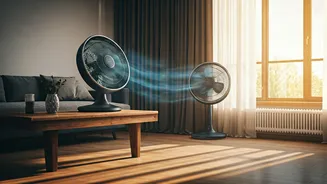
The effectiveness of fan placement is deeply intertwined with how air pressure and temperature zones are managed within a room. When a fan is directed outward, it can create a negative pressure, essentially a partial vacuum, which then compels the room to draw air back in. This influx is most beneficial when it's coming from a cooler, shadier part of your home, like another open window away from direct sunlight. However, a study using computational fluid dynamics revealed a more impactful strategy: fans blowing *inward*. This orientation cultivates a distinct 'cup-shaped' airflow pattern that embraces the entire room. Unlike a narrow stream aimed at a window, this circulating air mass effectively distributes throughout the room's volume. This internal circulation enhances heat transfer and accelerates the evaporation process on your skin, providing that sought-after cooling breeze that makes warm days more bearable. Simply put, inward-facing fans can amplify the perception of coolness through enhanced air movement.
Humid Climates & Strategies
The effectiveness of fan strategies can be compromised in environments with high humidity. When the outdoor air is significantly hotter and more humid than indoors, simply replacing the air isn't a practical solution for cooling. For instance, if it's 35°C outside and 32°C indoors, exchanging that air offers minimal relief. In such conditions, the focus shifts to 'convective cooling'—generating high-velocity air movement directly across the skin to promote evaporation. Research suggests that in these scenarios, directing fans inward, aimed directly at occupants, is a far superior method. The goal becomes influencing the *perceived* temperature through vigorous air movement, rather than solely trying to reduce the room's actual ambient temperature. This high-velocity airflow directly on the skin is paramount for creating a cooling sensation, making the occupant feel more comfortable even if the thermostat reading remains high.
Optimizing Airflow Timing
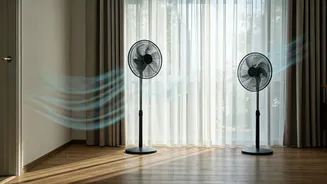
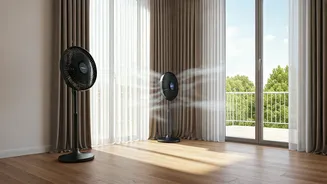
The timing of fan deployment is crucial for maximizing its cooling benefits. During the peak heat of the day, it's strategic to position a fan to draw cooler air into the building through windows located in the shadiest and coolest parts of your home. As evening approaches and the outdoor temperature drops below the indoor temperature, the strategy shifts to cross-ventilation. This involves using one fan to pull cool evening air into one end of the house while simultaneously using another fan to expel the warmer indoor air from the opposite end. This creates a rapid tunnel effect, efficiently clearing out accumulated heat and significantly lowering the room temperature in a short period, effectively combating the day's warmth.
Boosting Fan Efficiency
To enhance the effectiveness of your DIY cooling system, pre-planning your airflow routes is essential. Factors like dust accumulation on fan blades or dirty window screens can diminish performance. It's also advisable to position any intake fans in spots naturally shielded from direct sun, such as under trees or an overhang, to prevent drawing in additional heat from the external environment. Utilizing the vertical dimension of your windows can further amplify cooling. Since hot air naturally rises, installing an exhaust fan in a higher window and opening a slightly lower window on the opposite side of the house can leverage the 'stack effect.' This natural phenomenon encourages buoyant warm air to rise and be expelled more efficiently, akin to a breathing house. Thinking of your home as a system that needs to 'breathe' in summer unlocks its cooling potential.