




Introducing Comet MAPS
Prepare for an unparalleled celestial event as a newly discovered comet, designated C/2026 A1 and nicknamed MAPS, is poised to become an exceptionally
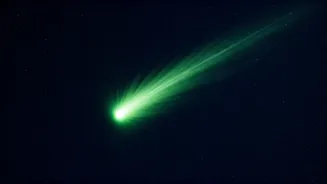
bright object in our night sky. This comet, identified by a team of French amateur astronomers in January 2026, is remarkable for its discovery location, far out in the solar system, suggesting a potentially massive size. As a member of the Kreutz sungrazer family, MAPS is destined for a daring dive near the Sun. These comets are known for their close encounters with our star, which sublimate their icy composition into brilliant gas and dust, creating spectacular displays. However, this proximity also carries a significant risk, as the intense solar heat can sometimes lead to the comet's disintegration. The unique composition of MAPS is expected to produce a distinctive turquoise tail, adding to its visual allure.
The Daring Sungrazer Family
Comet MAPS belongs to a fascinating group known as Kreutz sungrazers, a lineage named after the German astronomer Heinrich Kreutz. These celestial wanderers are fragments of a much larger parent body, believed to have been over 100 kilometers wide, which met a fiery fate near the Sun centuries ago, possibly between the 3rd and 4th century BCE. This colossal entity fractured into substantial pieces and numerous smaller fragments. These remnants have continued to follow similar trajectories, repeatedly venturing perilously close to the Sun throughout history. One notable example is the Great Comet of 1882, which achieved an astonishing brightness, appearing 100 times brighter than a full Moon and dominating the sky for extended periods. The current comet, MAPS, is the most distant sungrazer ever detected at the time of its discovery, hinting at its significant scale and the potential for an extraordinary display if it survives its close solar pass.
Viewing Comet MAPS in India
The peak of comet MAPS's journey, known as perihelion, is scheduled for April 4–5, 2026. At this point, it will skim incredibly close to the Sun, passing approximately 170,000 kilometers above its surface. Should MAPS withstand the Sun's extreme environment, skywatchers can anticipate a brilliant spectacle. Its predicted luminosity is expected to rival or even surpass that of Venus, the brightest object in our night sky. It's possible that the comet will be visible to the naked eye, even during daylight hours, a phenomenon made more remarkable by its characteristic turquoise tail. For observers in India, particularly those in southern regions, the best viewing window will be shortly after sunset, approximately 30–45 minutes past the sun's descent. The comet may appear low in the southwest. To combat the residual solar glare and enhance visibility, using binoculars or a small telescope is highly recommended. Those in northern parts of India might face more challenges due to horizon obstructions. Tracking the comet's precise position can also be aided by astronomy applications like Stellarium.