





The Nailer's Nemesis
DIY enthusiasts often face the dreaded moment when a hammer misses its mark, leading to painful finger injuries. While many accept this as an occupational
hazard, a surprisingly simple solution exists in everyday household items. The common wooden clothespin, often found in laundry rooms, offers a clever way to hold nails securely. This technique ensures your fingers remain a safe distance from the hammer's impact zone, transforming a potentially anxiety-inducing task into a more controlled and efficient process. By utilizing this humble tool, you can significantly reduce the risk of smashed fingertips and bruised knuckles, making home improvement projects much more enjoyable and less hazardous.
The True Cost of Missed Strikes
Hitting your finger while hammering might seem like a minor inconvenience, but it carries genuine medical implications. Reports indicate that injuries sustained from hammering are among the most frequent types of hammer-related accidents. Medical literature, such as a paper in Cureus, details how routine DIY tasks can escalate into severe fractures and lacerations requiring professional medical attention. When holding a nail manually, your fingers are directly in the path of the hammer, and a momentary lapse in concentration can result in an emergency room visit. The physics behind these misses involve a delicate balance between swing force and accuracy, especially in repetitive motions. Introducing a simple tool like a clothespin eliminates the human element of direct nail handling, mitigating this risk effectively.
Cost-Effective Superiority
While sophisticated tools like pneumatic nail guns are available, they come with their own set of drawbacks and significant costs. Even advanced technology has its limitations, as noted in studies featured in publications like the American Journal of Industrial Medicine. For the majority of household DIY jobs, the humble clothespin proves to be a superior solution. It is incredibly cost-effective and remarkably efficient, often outperforming expensive power tools in terms of safety and user-friendliness for common tasks. This simple hack bypasses the need for costly equipment, offering a pragmatic and safe alternative that ensures your projects are completed successfully without compromising your well-being.
Mastering the Clothespin Trick
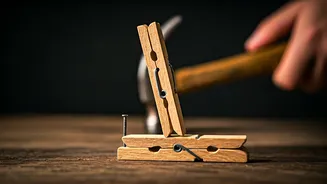
Implementing the clothespin trick is straightforward and highly effective. Begin by selecting a sturdy wooden clothespin with a strong spring. Insert the nail into the clothespin's opening, ensuring it's held perpendicular to the pin. This creates a stable base and positions your hand several inches away from the nail head. Gently place the nail against the desired surface and tap it lightly a couple of times to secure its position. Once the nail stands upright on its own, release the clothespin and proceed with your hammering. This method is particularly advantageous when working with small finishing nails or in confined spaces where hand access is limited, preventing accidental damage to the project's surface and preserving its finish.
Boosting Confidence and Skills
Adopting safe and simple methods like the clothespin trick can significantly boost a beginner's confidence. When teaching someone, especially a child, how to use tools for the first time, starting with this nail-holding technique eliminates the primary concern of accidental injury. This transforms what could be a frightening task into an enjoyable and educational experience. Ultimately, the most effective DIY hacks are often the simplest, most intuitive, and least expensive solutions. By repurposing an item commonly found around the house, you can prevent unnecessary injuries and ensure your projects proceed smoothly, making the entire DIY process more rewarding.